


I consider myself very fortunate to have been born and continue to live through an era of unprecedented prosperity and technological evolution with a world at relative peace. There are dire challenges to face to be sure, but I have optimism. Part of this optimism is fueled by the rapidity, in my single lifetime, with which political change has spread. In Europe we are witnessing the final vestiges of the Soviet empire all replaced by countries espousing democracies with the rule of law. If Ukraine emerges with a resounding victory, Putin will fall and Russia may be reduced to a number of much smaller countries. We might finally leave the consequences of World War 2 behind us.
Then there is the Pacific chapter of that great war. The results are less uniform but the successes therein are more spectacular. In the post war period we saw the progression from semi authoritarian governance towards the true democracies of Japan, South Korea, Taiwan, Singapore and Hong Kong and their enormous impact on the global economy. I would suggest that Vietnam would join their ranks in the next few decades. And unfortunately I would delete Hong Kong from that list now that China clearly intends to bring that city nation fully into the fold.
Nowhere is the stunning success of democracy over authoritarian rule more evident than the comparison between South Korea and North Korea. I qualify the success of a nation by the relaxed, quiet confidence its people have in its institutions and the happiness and satisfaction they have in their lives. My metric has been the influence their home grown culture has on the world at large. Canada has a small population but an oversized influence in world music, literature, theater, TV/film, and comedy. And so recently has South Korea as K-Pop, Korean film and now Korean television break out and become global phenomena.
The successes we enjoy are due in part to a period of enlightened post war American foreign policy and organizations like NATO allowing countries of the free world to push back against dictatorships everywhere. The forgotten war that I’m alluding to is Canada’s vital participation in the Korean War of the 1950s where Canadian soldiers fought directly against the disciplined and overwhelming forces of China’s People’s Liberation Army. Although the war resolved nothing and the Korean peninsula remains as divided as ever, Canada’s efforts and war dead continue to be celebrated and revered by the grateful citizens of South Korea.
The Korean War lasted just over three years from the summer of 1950 to 1953. More than 3 million died in that bitter conflict, greater than half of them civilians from the destruction of nearly every major city. Some 316,000 North Korean soldiers and 422,000 Chinese soldiers would be killed in action and as many as 400,000 more of them would die from disease. About 113,000 South Korean soldiers would die in combat and of the 15 member United Nations force sent to defend South Korea, the US would lose 34,000 soldiers and Canada lost 516. Over 25,000 Canadians fought in Korea and more than 7,000 remained there to help preserve the peace after the armistice.

Two days later the UN Security Council endorsed the burgeoning US military response as well as asking members to assist South Korea. Senator William Knowland of California would unfortunately coin the term “police action” to describe the UN response in an effort to emphasize the criminal nature of North Korea’s unprovoked invasion. This would forever seed in the public consciousness that the Korean conflict had neither the magnitude or rectitude of a full blown war. Despite the quick deployment of three RCN destroyers and six North Star transport aircraft of No. 426 RCAF Squadron to airlift supplies to Korea, the US wanted Canada to commit ground troops so a recruitment announcement was made to raise a 5000 men brigade. In the best Canadian tradition, response was overwhelming and recruitment centers were suddenly inundated with long lines of volunteers. But these recruits were not ideologically driven to serve like those in WW2. Many wanted adventure, had been too young to serve in WW2, were escaping dead end domestic situations or were WW2 veterans who had found peace time too difficult to adapt.
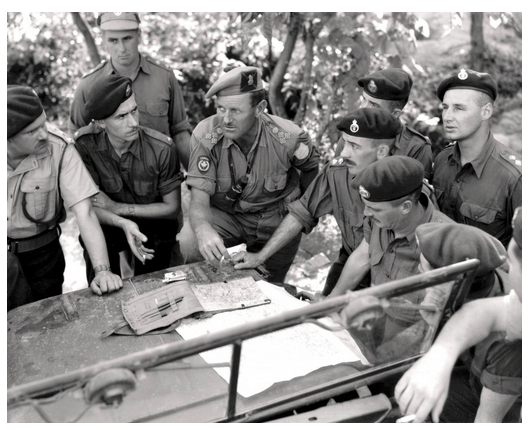
There are so many incredible tales to be told but I have to confine my discussion to only one specific event. The story is not gleaned from official regimental archives or the studied discourse of academicians. Most of the story is told by the men who fought, in their own words as documented by journalists who had the bravery to be embedded with the forces despite the extreme danger of death or capture. This is the story of the 2nd Battalion of the Princess Patricia’s Canadian Light Infantry (2 PPCLI) and its defense of Hill 677.
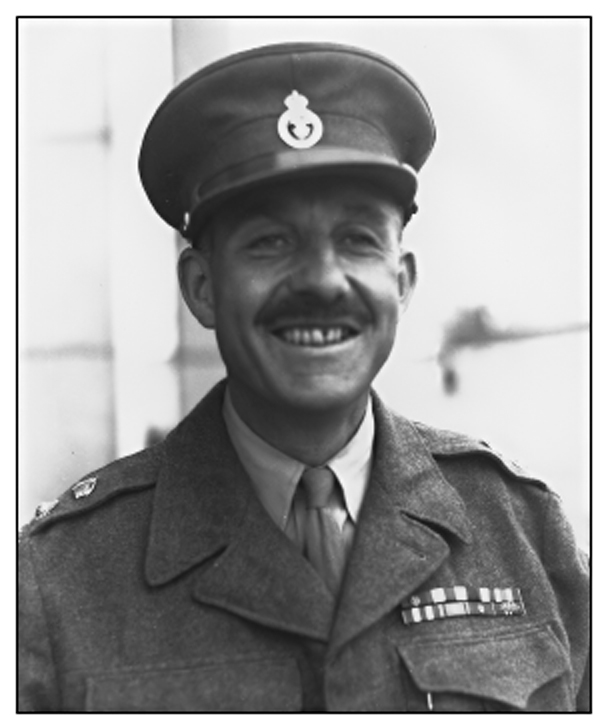
True to its motto of being “First in the Field”, PPCLI was the first Canadian infantry regiment in France in December of 1914 and was part of the Canadian Corps that captured Vimy Ridge in 1917. They landed in Siciliy in WW2 and moved to vicious street fighting to liberate the small Italian city of Ortona. After months of fighting in Italy breaking through line after line of German defenses heading up the spine of the country, they moved onto the liberation of Holland acquiring 18 battle honours by war’s end. The other war memories on the minds of the Canadian government were the death of 303 men and later 254 others who died in the atrocities of Japanese POW camps. These were the men of the poorly trained Royal Rifles of Canada and Winnipeg Grenadiers who had been sent to defend Hong Kong in 1941 against a Japanese invasion. Never again. Foremost was the selection of peerless leadership for 2 PPCLI and a pledge that 2 PPCLI had the autonomy to determine when its men were finally fighting fit for combat .
The Americans barely held onto their bubble around the port of Pusan while being reinforced by inexperienced occupation troops shipped from Japan for the first hundred days of the war. Then a bold amphibious landing of US Marines at Inchon some 160 km behind the North Korean army suddenly cut off their supply lines resulting in the North Koreans retreating in panic and disarray. General Douglas MacArthur attributes his tactical masterstroke to his study of the successful landing of General James Wolfe’s British army over the St Lawrence River and up the cliff walls to surprise the French forces of General Louis Montcalm on the Plains of Abraham outside Québec City. Everybody thought Wolfe was crazy. MacArthur’s own staff thought the Inchon landings impossible. Therefore, the North Koreans would feel the same way and never expect such a move. (This battle is why Canada is an English speaking country … and why Québec continues to exist as a vibrant French speaking entity. No other country in the world shares this this tolerant dichotomy of two official languages).
China informed the US that if its forces crosses the 38th Parallel then China would be compelled to enter the war if only to defend its own border with North Korea. MacArthur was also a man who had come to believe in his own mythology and scoffed at the idea. China lacked both an air force and a mechanized army with which to transport hundreds of thousands of troops to the front. Now was the time to eliminate the Communists from even China. He had visions of using tactical battlefield nuclear weapons to turn the Chinese border with North Korean into an impenetrable dead zone to prevent a Chinese incursion. On October 7th, the UN General Assembly passed a resolution to stabilize the entire Korean Peninsula and UN Forces crossed the 38th. In 75 hours the northern capitol of Pyongyang fell. Tens of thousands of North Korean soldiers were being captured during their rapid retreat into the mountains adjacent to the Yalu River.
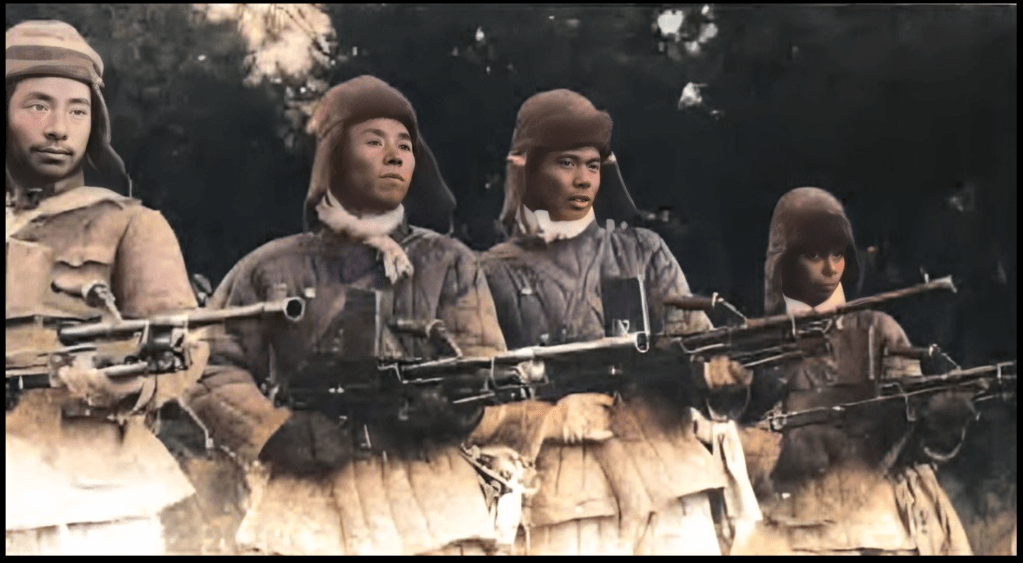
A jubilant MacArthur should have studied Chinese military history, in particular the recent long struggle between Communist and Nationalist forces in China. This was a classic Communist rearguard action maneuver. The North Koreans were retreating to prefortified positions in the mountains from which to strike down upon thinly spread out UN Forces in pursuit. But the final stage of the Soviet’s grand battle plan was just beginning to unfold. Hundreds of thousands of Chinese troops dressed in homemade brown colored quilted jackets with no rank insignia and rubber soled running shoes crossed the Yalu River. They each carried a week’s worth of rice and dried fish. The occasional captured soldier carried a handgun but most appeared to be poorly armed with World War 1 vintage bolt action Japanese or Russian Type R rifles. But they were young, fit and disciplined and traveled only by night. During the day the three division army hid in caves, and tunnels, and if caught exposed in the open by enemy aircraft would instantly come to a stop and hide motionless and camouflaged by their uniforms to blend into the terrain. This enabled the PLA to march 500 km in 19 days and absolutely surprise the UN Forces, driving them back with the ferocity of a tsunami and once again threaten the invasion of Seoul. This is the situation that greeted the 2 PPCLI as they arrived in Korea, the first Canadian troops on the scene.
The commander of the Eighth US Army wanted 2 PPCLI to enter combat immediately. Stone refused, his men needed at least six weeks of field conditioning and training. But your men are as well trained as ours. Stone looked derisively at the sullen green conscripts of the US Army. Precisely, but my men are fighting men. They came here to kill Chinese. Otherwise what’s the point. In the end the General could not overrule Ottawa’s orders.
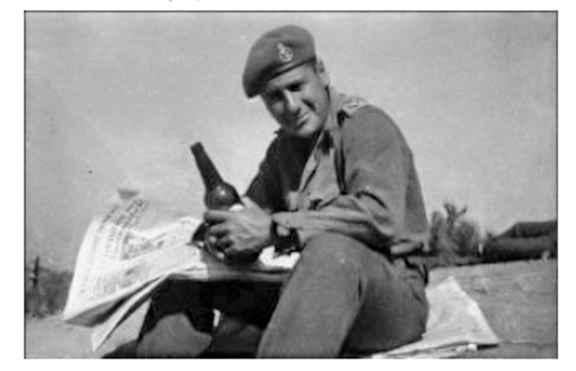
2 PPCLI had to also get properly equipped for combat, which meant disposing of most of their officially issued bolt action Lee-Enfield .303 rifles. Korea was a country of steep hills and deep valleys with no open flat fields of combat. The UN Forces would be fighting defensively and needed weapons that could lay down a volume of fire. The Chinese troops were now being regularly equipped with Soviet PPSh-41 submachine gun made under license as the Chinese Type 50. It had a tremedous rate of fire but was not particularly accurate at distance and lacked stopping power by using only a 7.63 mm round but excelled at the close range fighting that became typical in this war. The Canadians had the wrong weapons, but they also had a bounty of beer and hard liquor. This they traded with Americans for Thompson submachine guns or M1 Carbines, Colt 1911 handguns, .50 caliber Browning machine guns and bazookas. They needed a trailer to carry all the ordinance back to camp and the American supply Sergeant showed up with a two and half ton trailer towed by a truck. When the Canadians couldn’t pull such a large trailer with their Jeep, the Sergeant gifted them the truck as well. Curiously, when it came to hand grenades there were none better than Canadian #36 ones, which even the Americans preferred.
Stone’s training was tough and unrelenting. Those that could not physically meet the standard were shipped home. Troublemakers were dealt with harshly. When some soldiers foolishly drank fruit juice mixed with the jellied methanol from tinned heating fuel and died, Stone had no compunction while parading the rest of his men in front of the corpses to drive home the message. After which no Canadian ever succumbed to suspicious liquor offered to and accepted by other UN elements. Get off the roads, get up into the hills and hold the high ground. He felt the Americans were too reliant on tanks and air cover and reluctant to leave their trucks but he respected the US Marines. Like them he wanted his men to take the fight to the enemy, make the enemy worry about what you’re going to do next. Some of the best real world battle hardening would be encounters with Communist guerillas operating in the area. A pair of New Zealanders had gone missing. One had been found stripped and stabbed repeatedly through throat. Following a blood trail they found the second dead from blood loss with his wrists tied behind his back and one hand cut off. He had apparently been made to run in vain to find help before he bled out. The Canadians were incensed at the unnecessary cruelty. The guerillas were hunted down in the cold February winter from mountain top to mountain top until their cave headquarters were located and they were eliminated.
The Canadians were ready for combat and became part of the 27th Commonwealth Brigade fighting alongside English, Scottish, Australian and New Zealand troops and attached to them was a mobile hospital unit from India.
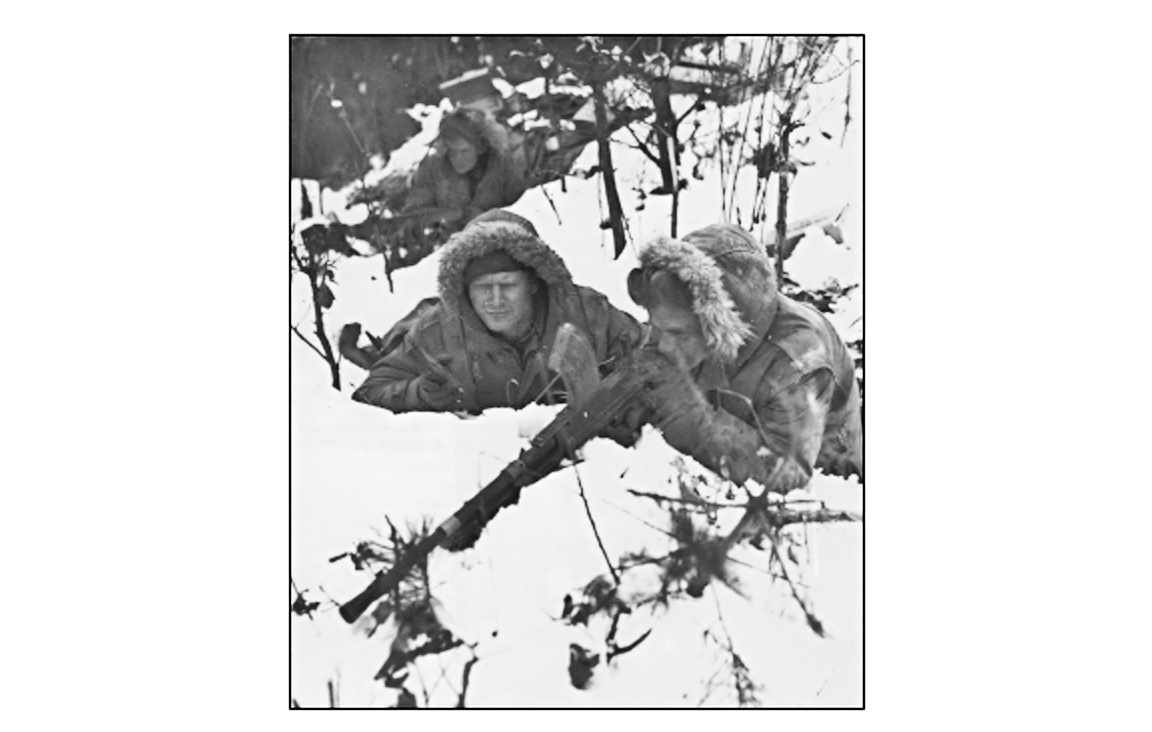
The Canadians continued to learn about the horrors of war. They came across a 98 member all Negro reconnaissance team, all massacred in their sleep and laid out frozen and naked along the side of the road after the Chinese had stripped them of all personal effects and weapons. They had failed to post sufficient sentries. Some clearly had been struggling with the zippers to get out of their sleeping bags before being killed. And the corpses had been booby trapped with grenades. Stone was never one to miss a teaching opportunity. He ordered everyone to throw away their sleeping bags and sleep in their parkas under a blanket in the bottom of a trench. And parka hoods were forbidden to be pulled over one’s head at night to hamper hearing. The story made it out two days later by the embedded journalists and all hell broke loose. The Pentagon grilled the Eighth Army HQ in Japan because the loss of an entire US Army Company was never mentioned in any official army briefing.
Omissions from the official archives were neither clerical errors nor uncommon. 12 Platoon of D Company came across a Chinese formation of two officers, 3 NCOs and 51 soldiers … all dead but sitting on their knees bolt upright at attention and in formation. They were extremely well equipped with quality binoculars, submachine guns, machine guns, grenades and mortars and wore unusual formal summer dress uniforms with brass buttons. There was no visible cause of death and the whole scenario was disturbing and unnatural. No official company reports ever made it into the 2 PPCLI War Diary where the regimental archives are kept in Calgary.
On Easter Sunday of 1951, 200,000 Chinese troops from the 2nd and 3rd Field Armies began a massive assault on the west central region of UN line in the Kap’yong valley with the intent to recapture Seoul. The US I and IX Corps fell back leaving two regiments of the 6th South Korean Division to hold the line. The next morning 30,000 Chinese crossed the Imjin River by night and the 1st Battalion of the Gloucestershire Regiment were attacked as well as the South Koreans north of Kapyong. By the next afternoon the British were in serious trouble and cut off. Still its commander decided to hold rather than abandon their wounded and wait for the relief column … which never made it. The next night only 40 managed to fight their way out but the rest of the battalion was decimated with 700 killed. An additional 39 died while POWs. The South Koreans broke far earlier and a long line of soldiers with huge numbers of civilians began streaming down the road past the Canadians on Hill 677. South Korean officers began shooting their own soldiers in an attempt to restore order and stop the stampede to no avail. No attempt was made to spike abandoned artillery and trucks full of ammunition and fuel were left for the taking to the Chinese. The Canadians witnessed the wild panic as drivers of military vehicles willfully ran over their fellow men.
Two miles to the east was the 3rd Royal Australian Regiment defending Hill 504 with 15 Shermans of the American 72nd Heavy Tank Battalion It was a much lower hill that made it tougher to defend as the Canadians looked down from their perch at the Chinese swarm. They attacked at night and by the next afternoon the forward Australian units had been battling waves of Chinese attacks for 16 hours and running low on ammunition. They were also 4 km behind the deepest Chinese advance and with armor support withdrew with 31 killed and twice as many wounded. This left the Canadians alone to stop the Chinese and prevent their progress down the valley towards Seoul.

Stone had used his experience fighting in the hills of Italy to determine the likely paths the Chinese would use to scale Hill 677. The hill was too large to be defended with each of his four companies supporting each other. Each company simply had to hold their position otherwise the hill was lost with the spaces in between covered by machine gun fire, mortars and artillery from the 16th Royal New Zealand Regiment stationed 4.5 miles away. Despite enjoying a 10:1 numerical superiority, the Chinese would have to carry all their heavy equipment and supplies up the steep incline while the Canadians could simply roll their grenades down and blow them off the side of the mountain.
What did the Canadians think of their Chinese opponents? They would advance briskly with six abreast … like disciplined Roman Legions. They were damned good soldiers. They were expert at night fighting and would fight regardless of the outcome. They were brave and tough but lacked individual initiative and faced punishment if acting without formal approval. This made it difficult for them when things went wrong, and in battle things always go wrong.
Each of the four companies were dug in but the soil layer was not very thick and the trenches could not be dug very deeply before soon hitting rock. Mortar crews had no choice but to keep their munitions in the open and exposed. The Chinese were quiet as shadows in the dark with their rubber soled running shoes but they pedantically always announced their attack with a series of bugle signals. Company B and Company D bore the brunts of the attacks as wave after wave of Chinese soldiers launched themselves onto Canadian positions and were driven back by gunfire, grenades and even hand to hand combat with bayonets.
At one point in the first night, Stone’s Battalion Headquarters at the summit was under threat as 500 Chinese silently closed from the lightly defended south. But at 100 yards, every heavy machine gun affixed to the row of parked half tracks opened up and tore apart every single enemy soldier. The encounter nearly exhausted all their ammunition but the display of thundering firepower made the Chinese think they were attacking a much larger and heavily provisioned enemy force and they never tried that approach again.
Mortar crews fired nearly vertically to eliminate Chinese soldiers nearly on top of Company B’s position.
The Chinese switched their attention to Company D and here Mike Levy demonstrated his fighting prowess by personally directing artillery fire to within 5 meters in front of his own men’s positions as he jumped from foxhole to foxhole to assess their predicament. Small arms fire was not enough, only the raining barrage of artillery was able to stop the Chinese attacks. Levy could hear the Chinese officer demanding his men advance and kill the American pigs. Levy, the polygot, switched to Mandarin and shouted that they were Canadians and that all of them (insinuating very large numbers) were just waiting for the Chinese to try again. Infuriated, the Chinese officer began to hurl personal insults at Levy, who replied in turn until his men implored him to stop.
By six o’clock in the morning the Chinese finally gave up. It was only the mortar and artillery attacks that had broken the Chinese assault and both Company B and D were out of ammunition. Company A and C had seen little action and shared what they had left But it would not be enough to last another night. Stone called for an air resupply and incredibly after only 6 hours four C-119 transports from Tokyo flew over their positions and accurately dropped everything they needed. The Chinese could see the Canadians had been freshly rearmed. The following night was quiet with the occasional minor firefight as they observed a long line of Chinese troops heading north on the valley floor.
The New Zealanders had fired 14,500 artillery shells in support of their Canadian cousins. The 700 Canadians had held off two Chinese regiments with a strength of 6000 troops and had only suffered 12 dead and 23 wounded. Estimates of Chinese dead are difficult because the enemy always carried them away but could be as high as 4000. It had been a near thing. If the Chinese had continued their assaults though the following first morning they would have broken through but perhaps they thought the Canadian force was larger than it was. Even the most disciplined army can only take so many losses and the macro view is that China wanted to demonstrate its resolve to the West and that the “sleeping giant” had finally awoken. For the Canadians, their remarkable esprit de corps had carried them through a harrowing battle because in combat men fight for their fellow brothers in arms. There were so many examples of individual bravery that I urge you to read them for yourselves, and not a dry eye will prevail. So remarkable was the action that 2 PPCLI remains the only Canadian unit to ever receive a US Presidential Unit Citation.¹
.
.
.
¹Much more recently, JTF2 also received a US Presidential Citation for its work in Afghanistan after the terror events of 9/11 but their activities remain classified so it is very difficult to discuss and acknowledge their exploits in the same context as 2 PPCLI. And frankly, the Taliban is not an equivalent fighting force to the PLA.
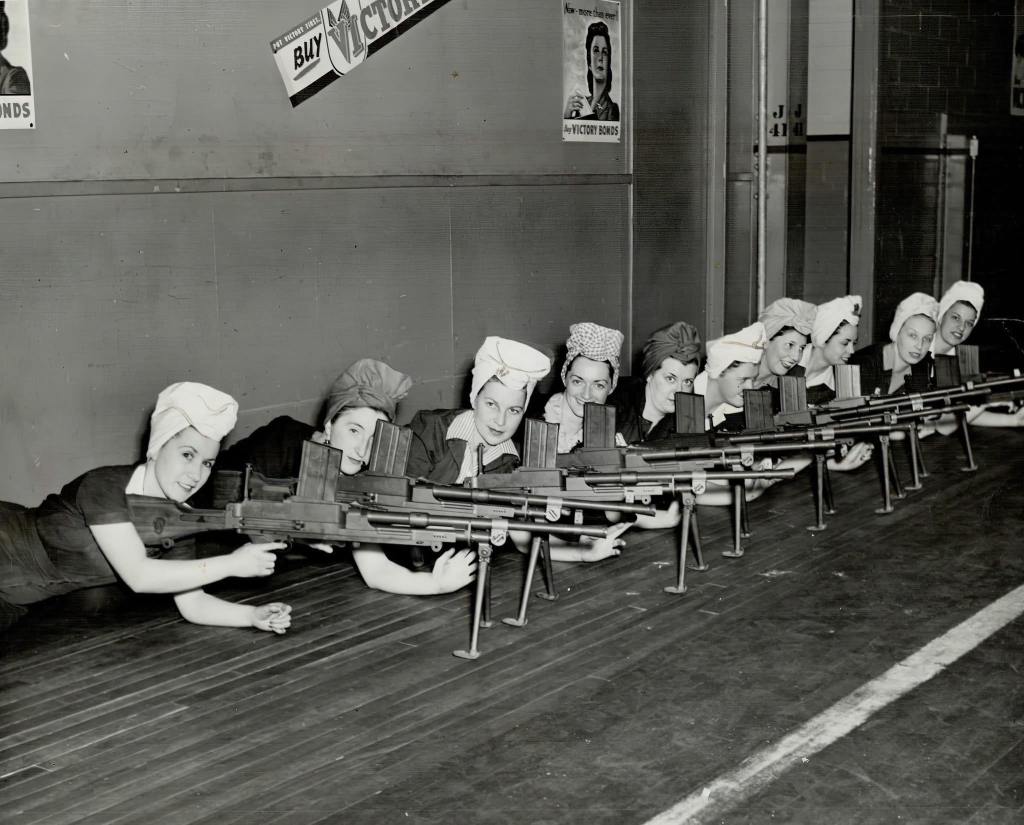
²These guns would come back to bite the Canadians as they were captured in large numbers by Mao’s Communist Forces during the continuation of the country’s civil war with the Nationalists resumed after the Japanese capitulation and were then used by the PLA in Korea. These were known as the Boran 7.92mm light machine gun, made in Canada!

 Jim Chung's Ramblings
Please delete your trash ass blog ya clueless donkey.
LikeLike
Every time I see your utterly stupid comment I am reminded that there will always be a segment of the human population BELOW average in every regard. I could delete your clearly idiotic comment … but it’s here to remind every visitor how moronic some humans can be.
LikeLike
Do you understand that you’re desecrating the memory and honor of real men who bled and died to ensure the freedom of others. Including pathetic individuals like yourself who hide behind false accounts.
LikeLike