The First Bonneville Rx7

Car & Driver Magazine has had a long association with speed record breaking attempts at the Bonneville Salt Flats in Utah.  There are some 491 classes for cars alone so there is abundant potential for breaking a record as well as for holding one for some time.

RX4
In 1974, technical editor Don Sherman pushed a Racing Beat modified Mazda Rx3 to 160.393 mph.  Racing Beat would become known to all Mazda rotary engined car owners as the leading rotary tuning shop and would go on to manufacture and market many bolt on components that would yield real horsepower gains.   Founded by Takayuki Oku and Jim Mederer in a former Anaheim ice cream shop, their first project was a Car & Driver sponsored 1973 Rx2 to compete in the IMSA RS (Racing Stock) series.  Mederer bridge ported the stock 95hp rotary engine to produce 198 bhp and with a racing exhaust made 218 bhp at 8400 rpm.   Dyno runs of the traditionally loud rotary engine could be heard more than three miles away and the car easily took pole position in its first outing at Pocono and won at Lime Rock and Road Atlanta.
Rx7a
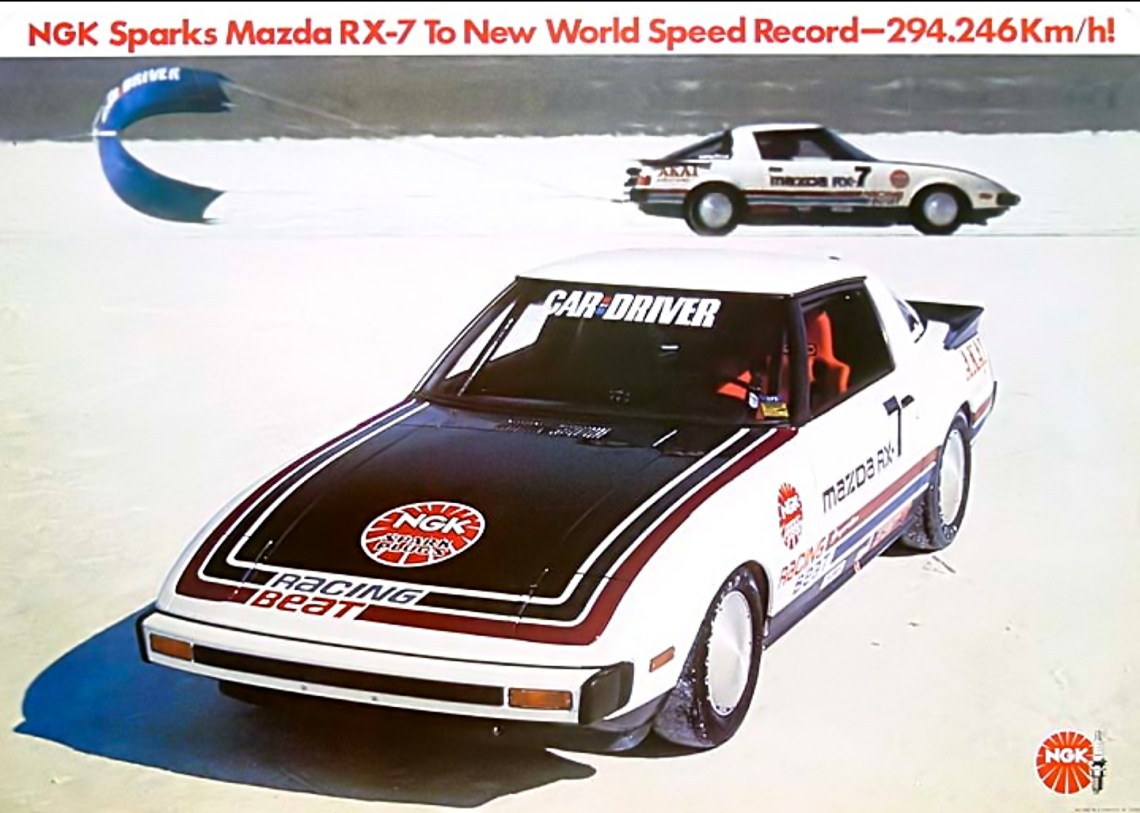
Don Sherman was at it again in 1978 with the debut of the new Mazda Rx7 model hitting 183.904 mph and setting a new record for the Class E Grand Touring car category for production sport cars under 4.0 litre displacement. The 13B engine used displaces 1.3 L combined over its two rotors.
RBa
The car was prepared by Racing Beat with Oku and Mederer  posing over the open engine compartment of the Bonneville Rx7. Any resemblance of Mederer to Carroll Shelby is intended, his cowboy hat wearing affectation at the track was a conscious imitation. Mederer is leaning on the cold ducted air intake filter assembly that sits on top of a massive 58 mm downdraft Weber feeding a peripheral ported 13B engine.  Each rotor chamber was jetted differently to produce equal exhaust gas temperatures and a crankshaft triggered ignition system used instead of the stock distributor which at high rpm would produce backlash that affected timing consistency.   One degree of timing error can produce a loss of 5 bhp.   The engine produced 326 bhp at 9750 rpm but since Bonneville is at 4200 feet elevation there was a 17% loss of horsepower.
Interior
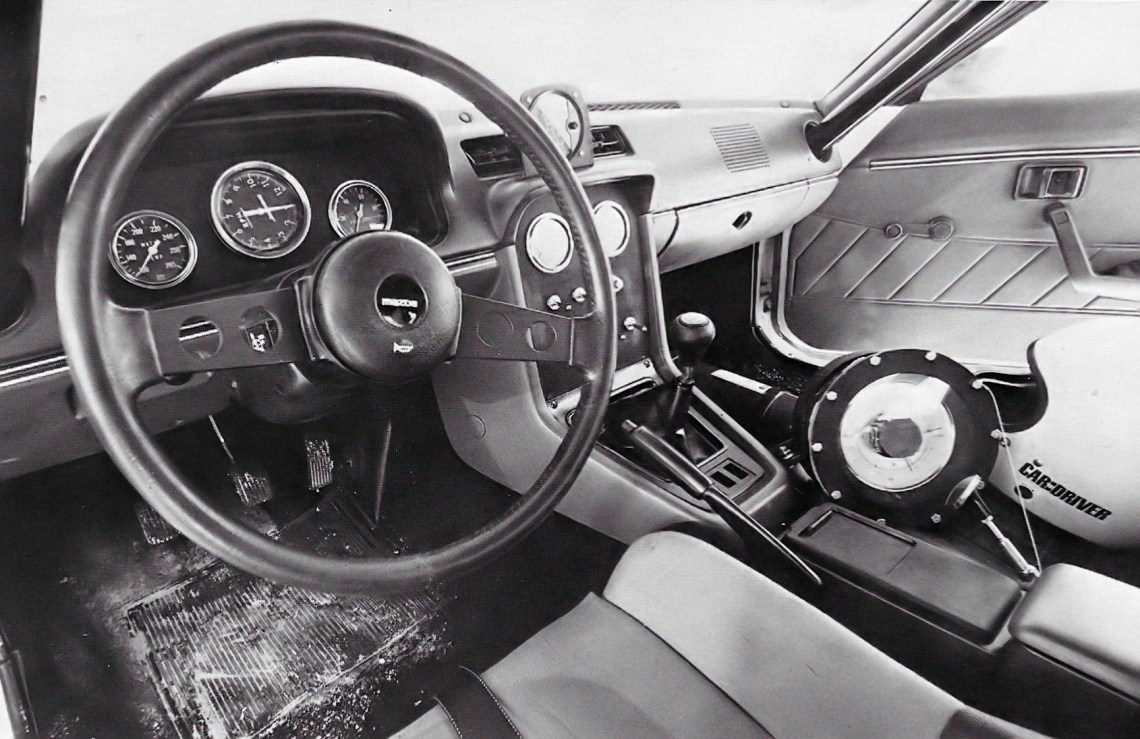
The modified interior showing a roll cage going through the air conditioner vents, changed instrument cluster, a fire extinguisher, the parking brake handle is now the parachute release. Ironically, the parachute was used only for the publicity photos – as aerodynamic as the Rx7 is, at these speeds the car slows down quickly once off throttle. The stock 4 speed transmission is used since the gear ratios are better suited for racing than the (then) optional 5 speed unit.  A needle roller bearing is put in the housing to eliminate heat buildup at sustained high speeds.
RB2
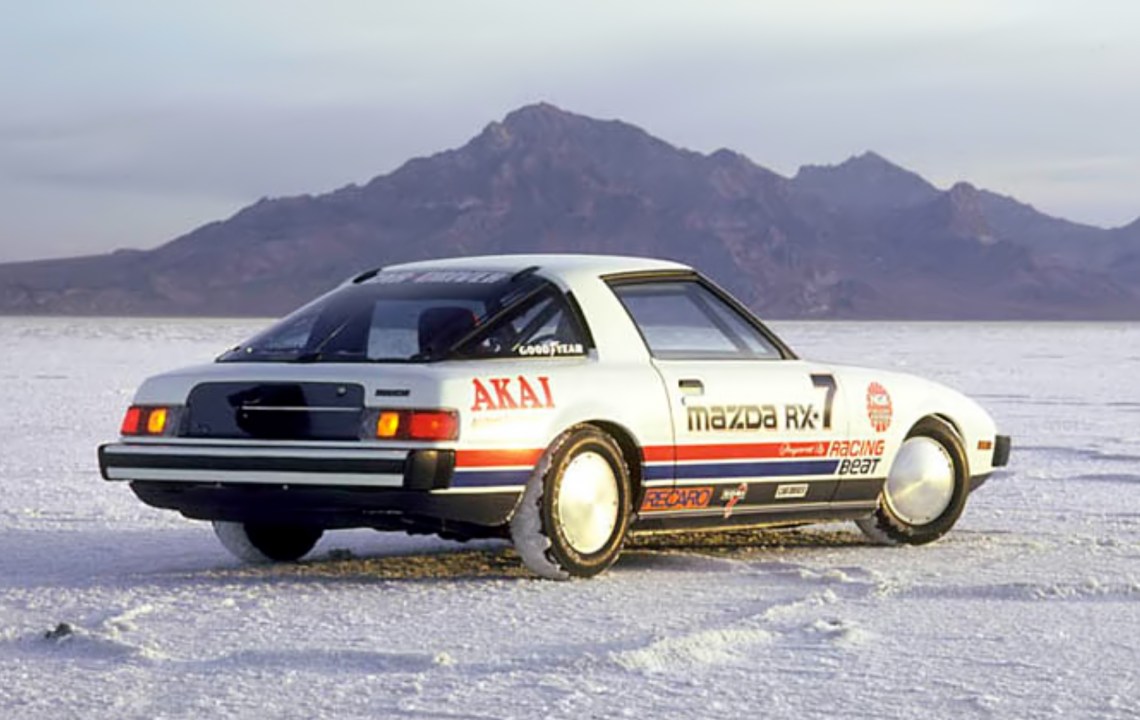
The Bonneville rules are that the car’s bodywork be kept virtually stock although equipment that was optionally available from the manufacturer was allowed to be used. The factory IMSA rear spoiler was used in the final speed run and significantly increased the top speed.  22.0×6.0 – 13 inch Goodyear racing tires were used with the sealed stainless steel covers and the suspension lowered.
BonnevilleRx7c
There’s me at Bonneville with the Rx7. Of course this is another one of my forced perspective images using a 1:43 scale diecast model car. I had to wait for the first light snowfall of the winter season that occurred 100km north of Toronto (Toronto will not be having a white Christmas this year) to simulate the salt crystals of the dried inland sea bed at Bonneville.  Even though I’m in a short sleeved shirt, I can assure you it is cold!!

NGK

Leave a comment