I know a little something about the competition history of the first generation series of Mazda Rx7s – but I clearly do not know it all. I was just recently both pleasantly surprised and shocked to learn that a SA22C Rx7 competed in the 1979 Monte Carlo Rally – and represented the one and only time an Rx7 competed in this event. This is a surprising fact for many reasons. Regular readers will be familiar with the exploits of the MTRE (Mazda Team Rally Europe) with their Group B prepped Rx7s in the early 1980s but they chose to only run their Group A 323 Turbo car at Monte Carlo (not to be confused with the later 323-GTX Turbo AWD which won the WRC1 in 1987). I suspect the Rx7 lacked the grip to be competitive on the snow covered stages in the Alps.
1 World Rally Championship
It is further surprising because Mazda is a small automotive manufacturer with a proportionately small racing budget and they chose to concentrate on the North American market where the vast majority of Rx7 sales would ensue. Mazda was so focused on commercial success that they priced the Rx7 significantly cheaper in the US and Canada than in Europe. This also explains the strong factory support for IMSA racing and the stunning freshman performance of their two factory prepped Rx7s at the 1979 24 Hours of Daytona.
Consequently, MTRE received very little factory support making it an absolute anomaly at how an Rx7 found its way into the 1979 Monte Carlo Rally!
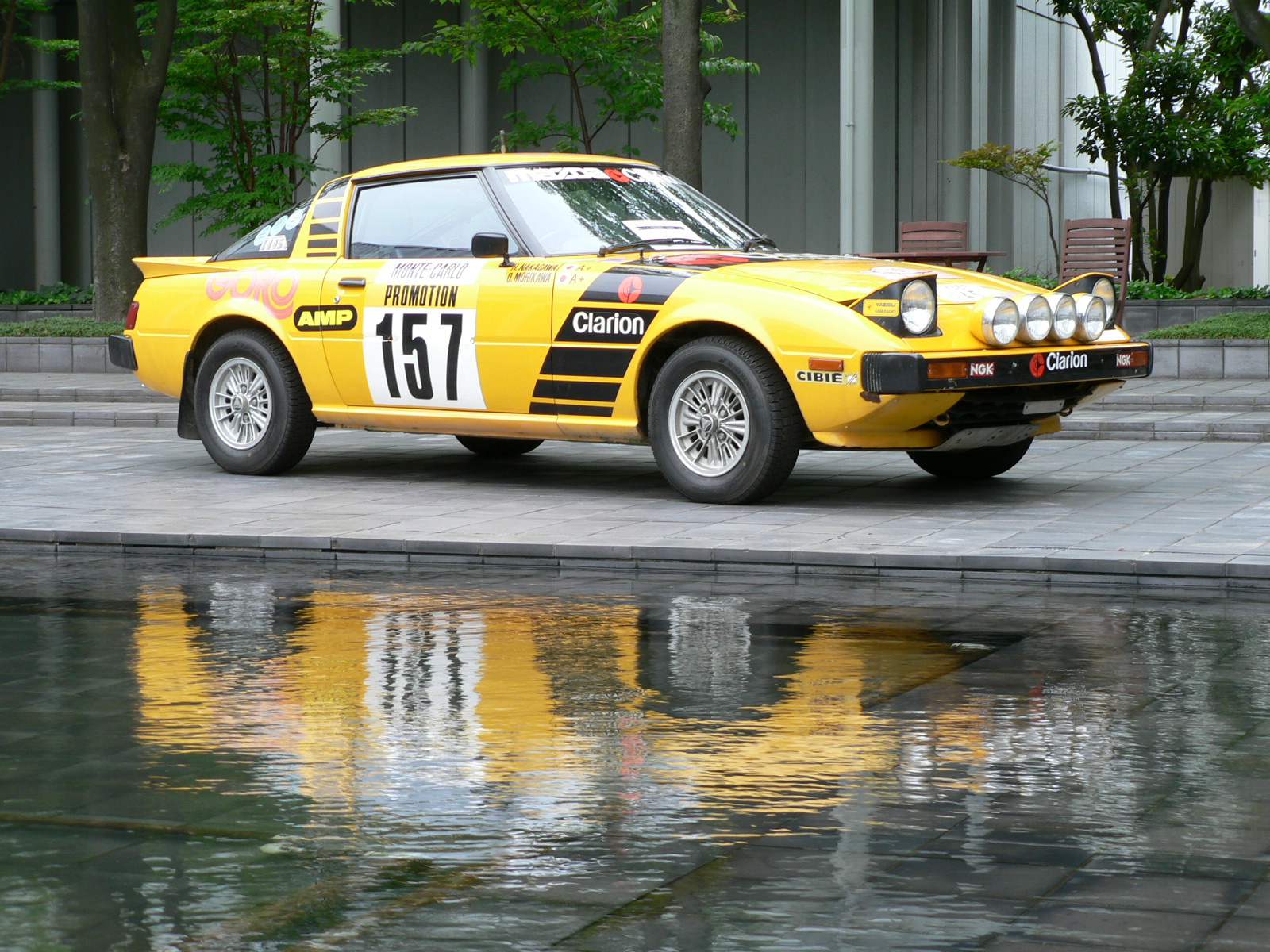
Hajime Nakagawa and codriver Osam Morikawa entered the SA22C Rx7 in the 1979 Monte Carlo Rally as privateers and won first place in Group 2, Class 4 (engines displacing over 2.0 L but under 2.5 L). In overall standings they finished a very credible midfield at 73rd out of 154. With 99 entries that did not even finish. The Monte Carlo Rally is an important event in the WRC because of its long history and association with the glamour of Monaco. But like its F1 counterpart, neither race is a particularly outstanding competition. The Rally in Kenya has more breathtaking scenery. The Acropolis Rally in Greece is much more physically arduous.
Today’s Monte Carlo rally runs fours days with 18 stages over slightly more than 300 km of completely paved surfaces but back in 1979 it was twice as long with the traditional last day involving the famous climb from sea level to the 1.6 km summit of the Alps along the Col de Turini, a series of climbing switchbacks connected by hairpin corners. This is usually run at night (is it better that you can’t see the sheer drop off into the Mediterranean?) famously referred to as “The Night of Long Knives” describing the parade of headlight beams stabbing into the next dark corner. And there are still massive crowds of spectators lining every available roadside inch.
Predictably, there is almost no digital trace with which to compose the story of Nagakawa-san and Morikawa-san, but I was determined to write it. By chance I came across a decades old magazine story from the French publication Autoretro featuring the two men’s participation in the 2009 Historic Monte Carlo Rally in the original car with original members of the support crew.
Then a search thread uncovered a Danish article about a driver who was active in the 1970s and 80s (driving 911s, BMWs and Rx7s) and returned to the track in 2010 with an FB-Rx7. He also operated a Mazda dealership in the town of Odder and campaigned a 1968 Mini Cooper in the 2013 Historic Monte Carlo Rally driven by the team of Nagakawa and Morikawa! I reached out to Preben Kristoffersen and he graciously put me in touch with Morikawa-san! (sadly, Nagakawa-san was diagnosed with dementia and has been living in a nursing home for the past decade).
Left to right: Hajime Nagakawa, Preben Kristoffersen, Osam Morikawa
Both Hajime and Osam live the dream embraced by so many automotive enthusiasts (myself included). Ostensibly, the two men don’t earn a living being professional rally drivers but indulge their racing passions by competing with a self financed car and team. Both of them still bore the sting and financial burden of having to retire early with their Datsun Sunny KB110 in the 1977 Monte Carlo Rally when they saw an unexploited opportunity with Mazda’s brand new SA22C Rx7 in early 1978. Somehow, their audacious written proposal found a welcome reception with Mazda’s Executive Officer of Public Relations and a green press car was made available along with sponsorship from Clarion Electronics and Yokohama Tires. The car was sent to be lightly prepped by a tuner acquaintance, Ryoichi Inose, who later served as the team mechanic. Close friends made up the remainder of the support crew and they paid their own expenses because delays required the car be air shipped to France in order to arrive in time for the Jan 20th start date of the rally, draining the entirety of the operating budget.
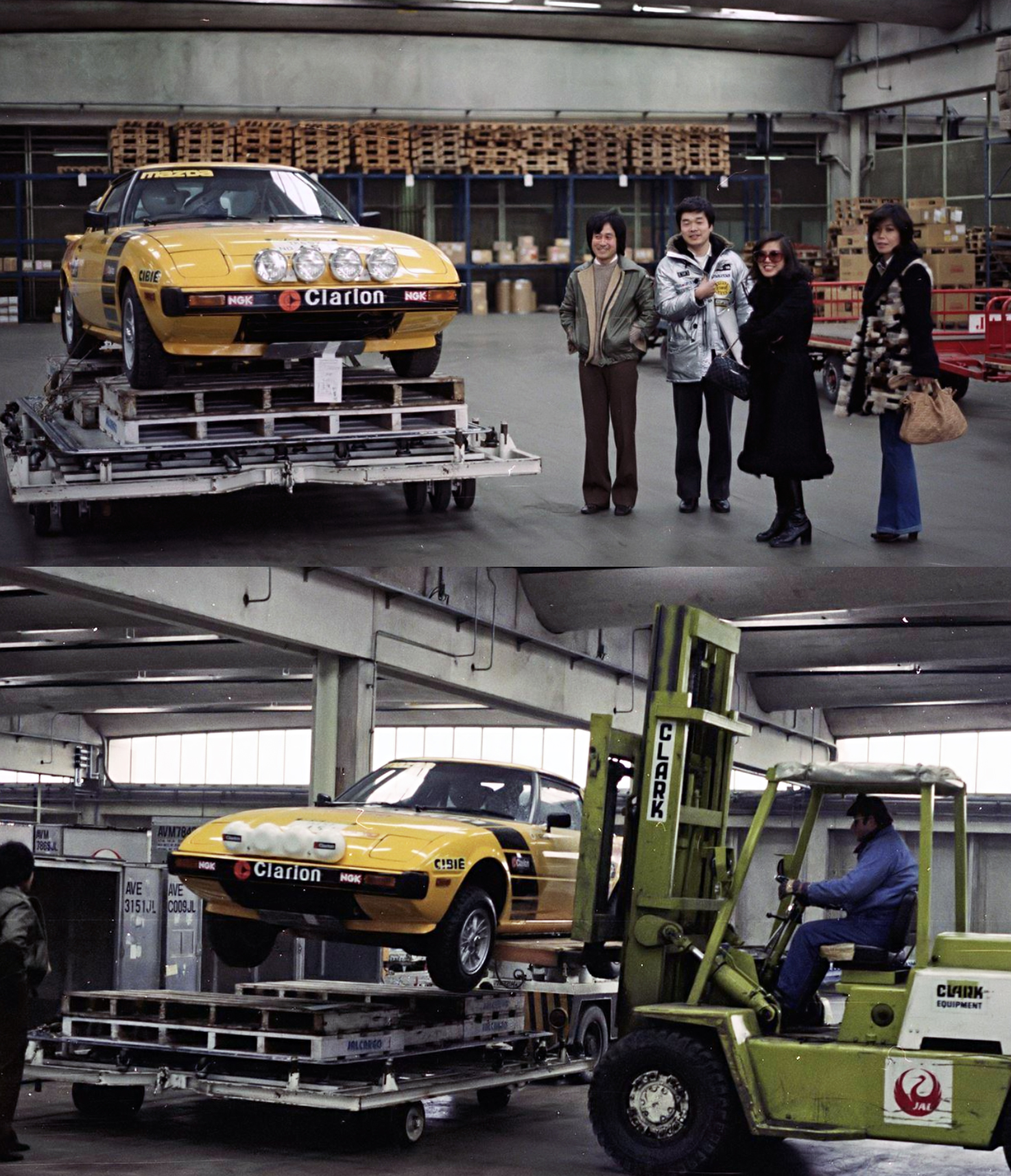
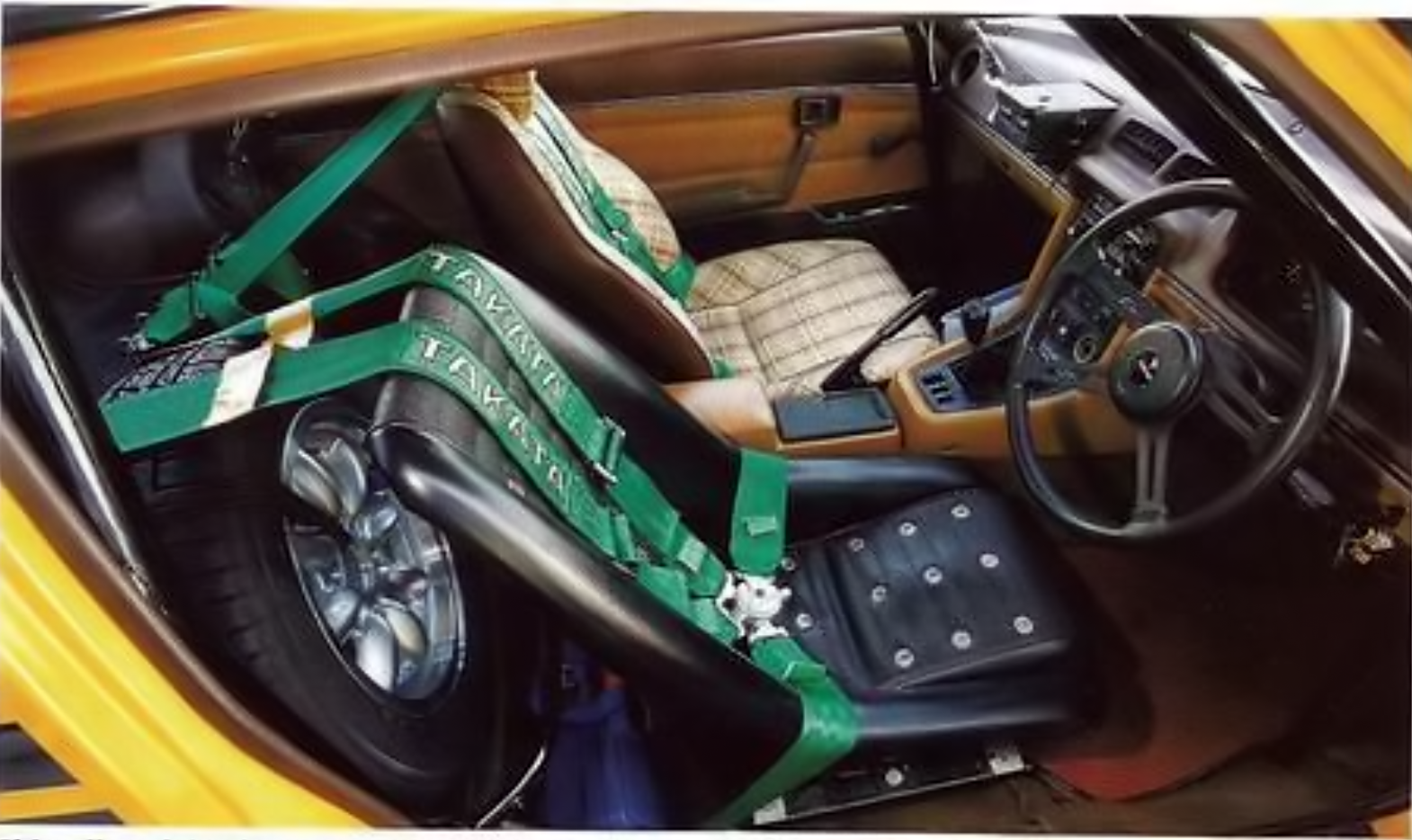
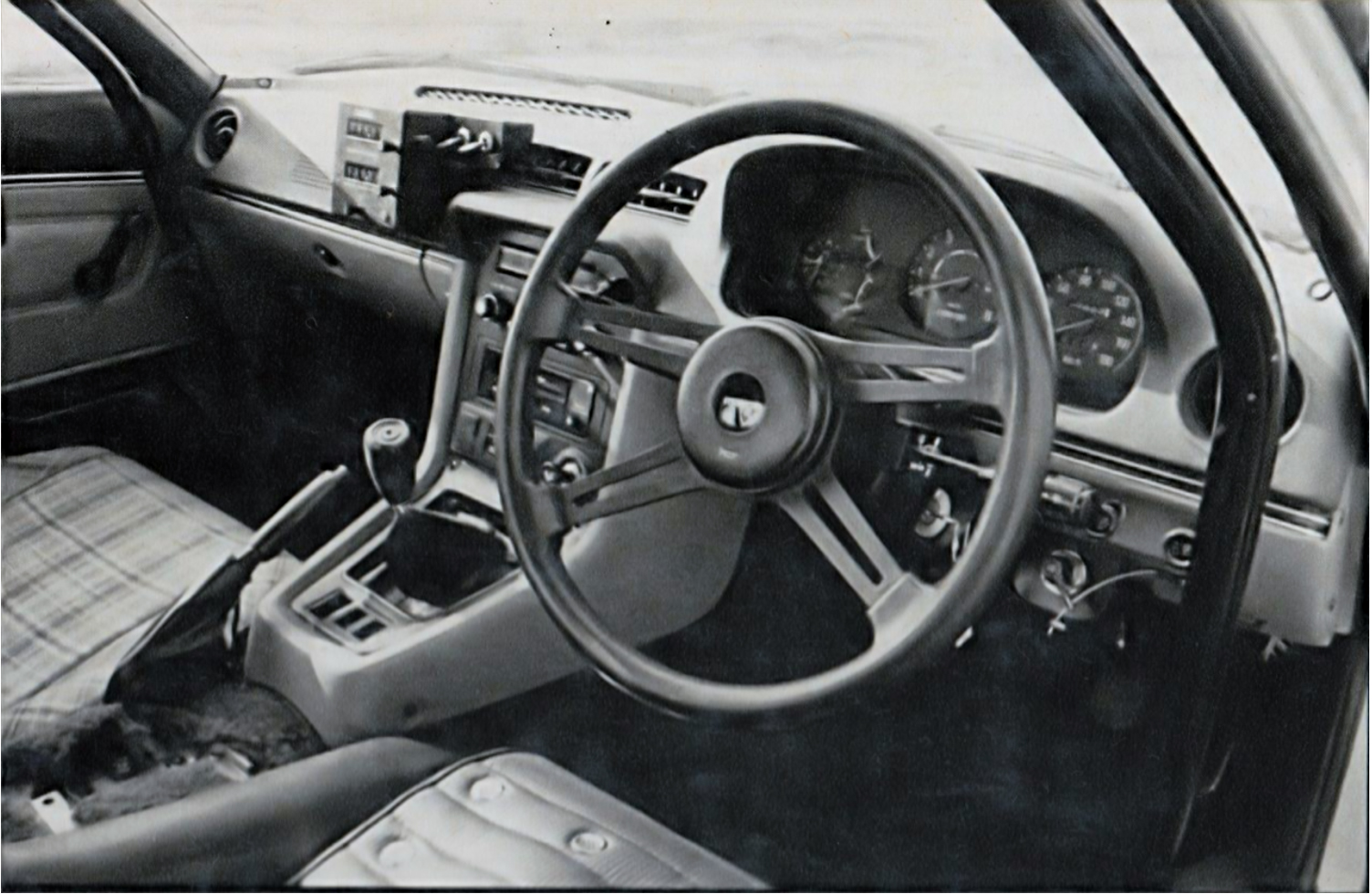
The Rx7 was air shipped to Paris on Jan 10th and arrived intact on its palette and is skillfully unloaded with a fork lift. Can you imagine the shipping cost? Return to Japan after the rally was by sea transport.The stock interior has been upgraded with a roll cage, kill switch, full harness seatbelts, fire extinguisher, a helmet bin, and a customized driver’s seat. The JDM rear seat has been removed to allow the car to carry 4 spare tires/rims in the back. Osam recalls purchasing a Halda Tripmaster which is a precision odometer installed just in front of his seat where he sits as codriver. His vital duty was to act as navigator (although he did perform brief driving stints when Hajime was too exhausted) and follow the stage course as directed on official rally maps. One display would show entire elapsed distance from the start of the stage and the second could be zeroed at will to show incremental distance covered to help determine the correct turnoff required by the route. Here, it appears that two Tripmasters are mounted side by side although Halda does make a dual display model called the Tripviewer but the displays are mounted vertically.
Osam did not have time to make custom pace notes as is common practice today where the higher speeds afforded by all wheel drive make the specific nature of the upcoming turn vital for the driver. GPS also negates the need for devices like this.
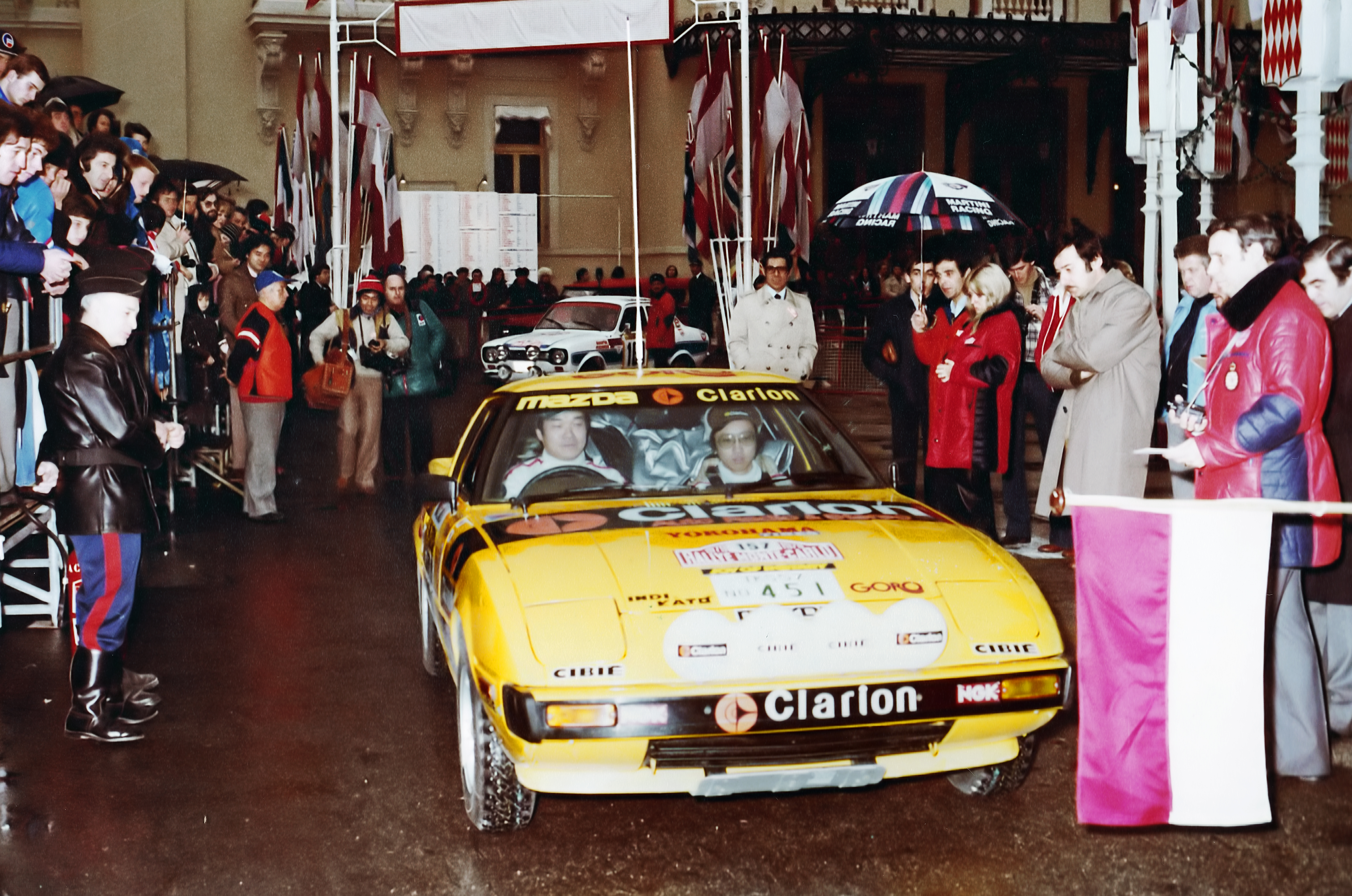
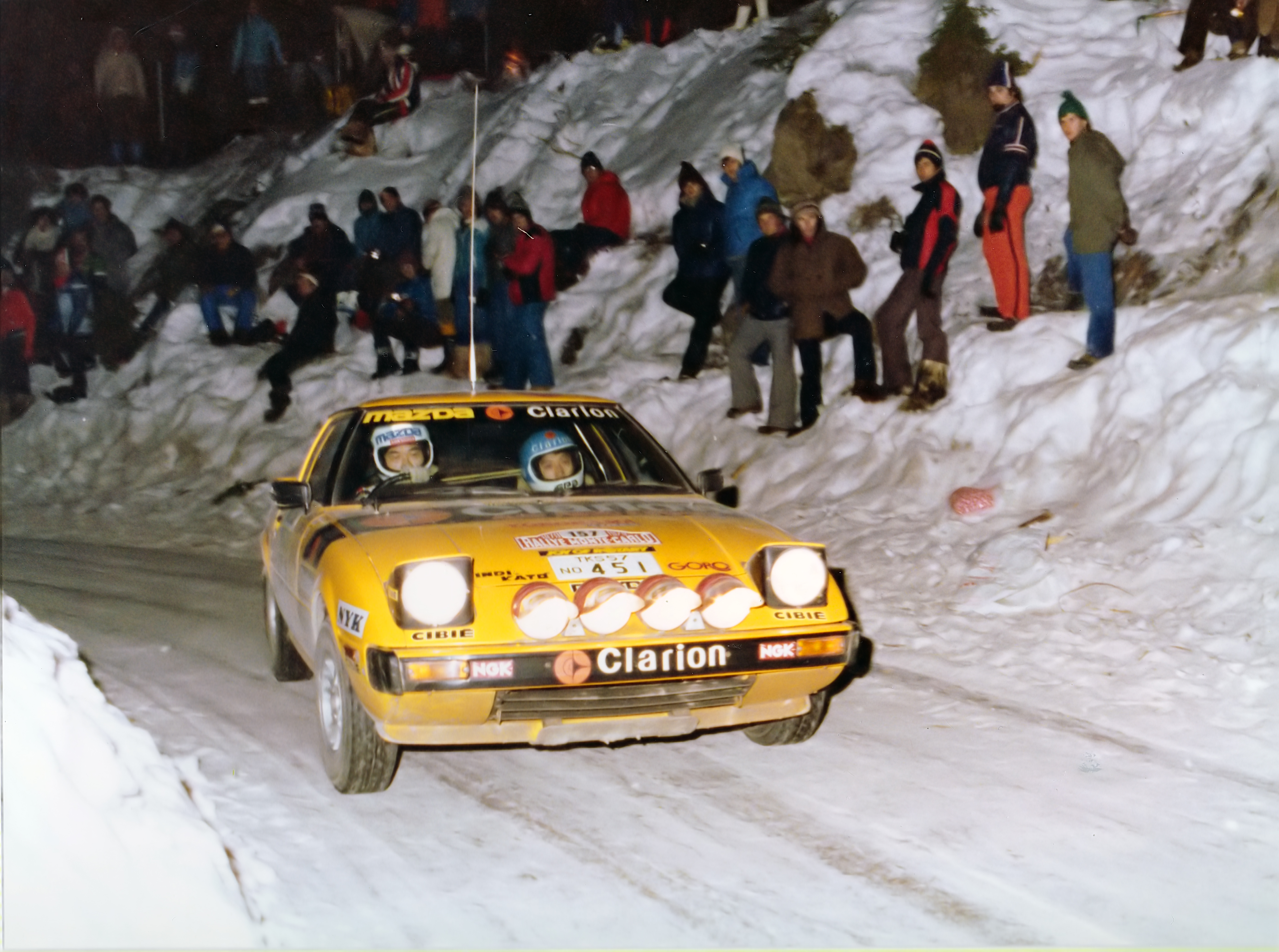
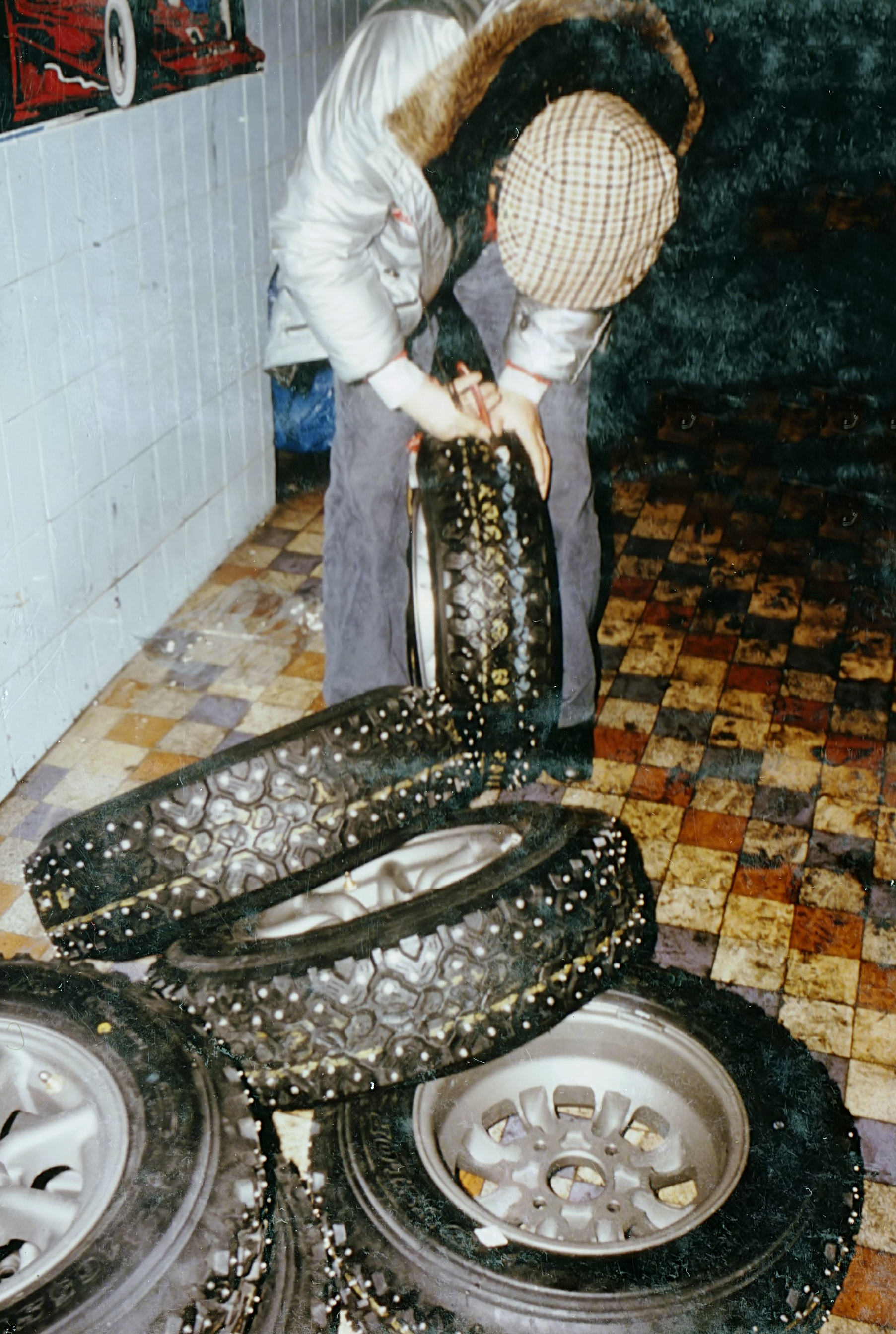
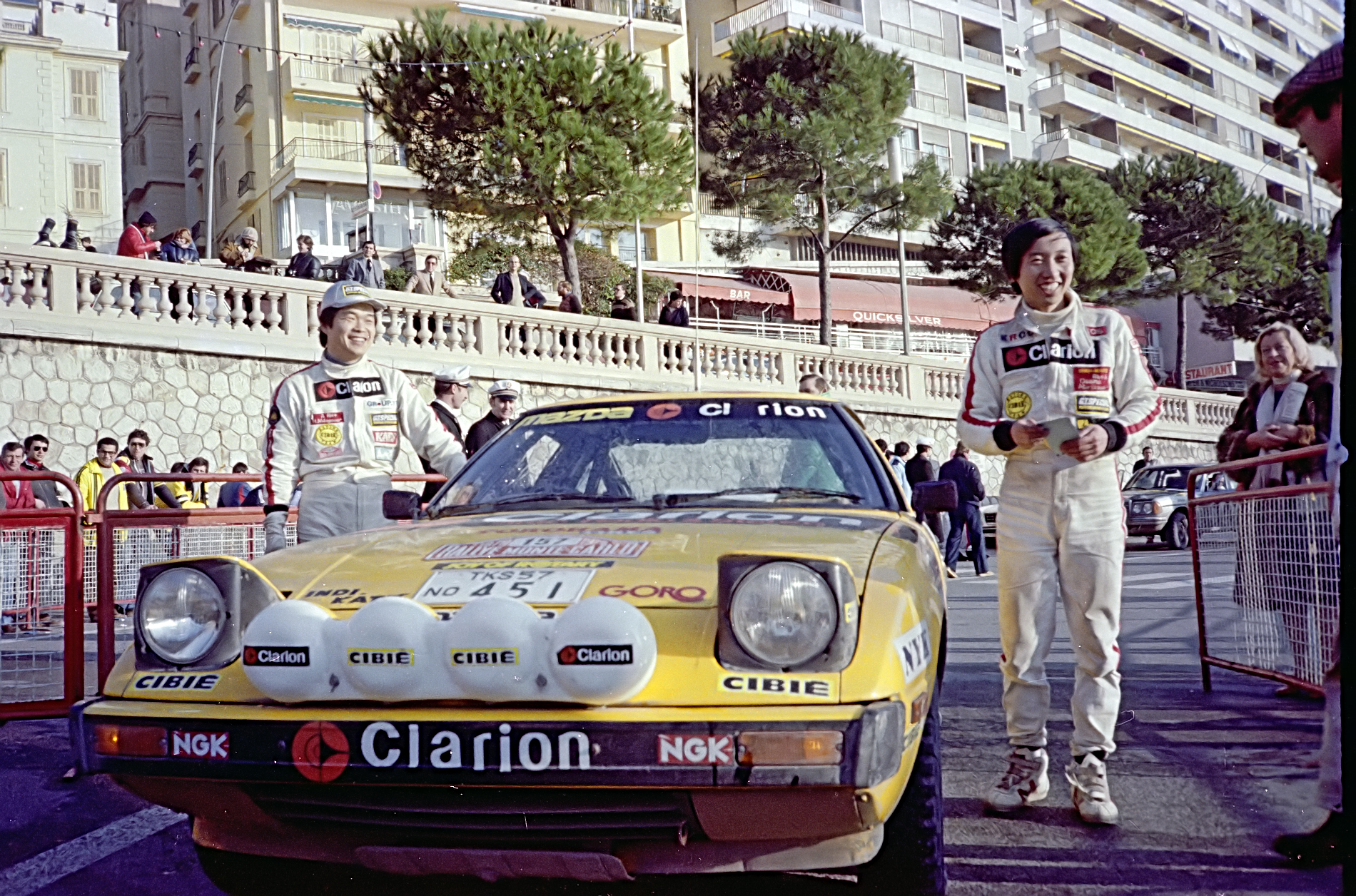
The mystery deepens! This photo was taken in late 1978 and clearly shows the Halda Tripviewer in place. The switchgear pertains to the lamp installed for map reading and Clarion also installed a full stereo cassette head unit although there is no mention if any music was ever played during competition. At some point the computer was swapped out before the car reappeared in the 2009 RMCH.At the official start of the rally. That is the flag of Monaco and not some obscure rally race flag! The Rx7 was almost completely standard with no engine modifications. Final drive gear ratio was slightly lowered from 3.9 to 4.375 and a LSD installed to ease mountain driving using racing Rx3 parts. Transmission, brakes and suspension was also stock with custom dampers installed. The fuel tank was enlarged to 90L due to the poor fuel consumption of the rotary engine. A larger capacity alternator and battery was installed for better cold weather performance and the heavy cast iron thermal reactor and air pump replaced with a stainless steel header. Unknown to Osam, this simple deletion would give the car an instant 20% boost in horsepower. The car ran flawlessly and gave no mechanical failures.There was more snow than usual in 1979. Starting from Monte Carlo and driving N202 towards north from Nice, roads were covered by snow. Several special stages (SS) were covered by snow/ice such as SS-6 Burzet, SS-6/22/27, & Col de Turini. They started with only one set of studded tires which was the correct call for a private team with limited resources. Those studs were absolutely needed to negotiate the snow and ice but did not let the Rx7 shine on the bare tarmac stages where a second set of wider and lower profile summer tires could have let them make up lost time.The team was initially concerned that the scrutineering process was taking far too long but it turns out the rally officials had never seen an Rx7 before and were fascinated with the novelty and of course its rotary engine. It did turn out that there were too many studs installed on the tires requiring some to be removed. The team manager came to the rescue by raising enough money from casino wins to purchase another set of tires.After a hard week of charging, the traditional end at the Place du Casino, in Monaco. Hajime on the driver’s side at the left, Osam on the right.
“For myself, the 1st stage Parcours de Concentration was not easy. The rally organisers did not provide Tulip maps until the 2nd stage so I had to use Michelin road maps to follow the route. There were several incidents on the route. The most serious one was at SS-18 in latter part of 3rd stage Parcours Commune. My driver lost the control at one downhill corner from Col de Corobin and went off the road. The Rx7 narrowly escaped falling off the cliff but got stuck on the snowbank. I shouted out to spectators around to help push the Rx7 but it was not successful because the rear wheels were floating. Then I found one fat guy there and asked him to sit on the rear spoiler and spectators kindly pushed the Rx7 back onto the road. We lost more than 6 minutes!”
After they discovered that Mazda had preserved #157 in its collection, Hajime convinced them to allow them to run the 2009 Historic Monte Carlo rally (RMCH) with it. Nearly every member of the original support crew joined them, some 30 years later. Ryoichi had gone on to create the Formula Nippon race team Nova Engineering which in 1997 employed future F1 star Pedro de la Rosa. Team Manager and occasional card shark Akihiro Hayahsi also returned.The team was very popular at the RMCH because the car was the real thing, not a tribute car built to resemble a past competitor. The driving team was original as was the support crew. The authenticity was unprecedented.Goro magazine was owned by Clarion and knew no journalistic boundaries in promoting its parent company through the Monte Carlo Rally experience. “Entry #157 Team GORO dominates Opel, BMW and Porsche” may have technically been true in that the Rx7 did beat an Opel, a BMW, and a Porsche entry that may have crashed and did not finish the race. In the next issue the title reads “Team GORO wins Monte Carlo” implying it beat the first place Lancia Stratos pictured below when the win was a Class win. Where did Team Goro come from, well there is a red GORO sticker on the rear flank of the car as well as on its roof!
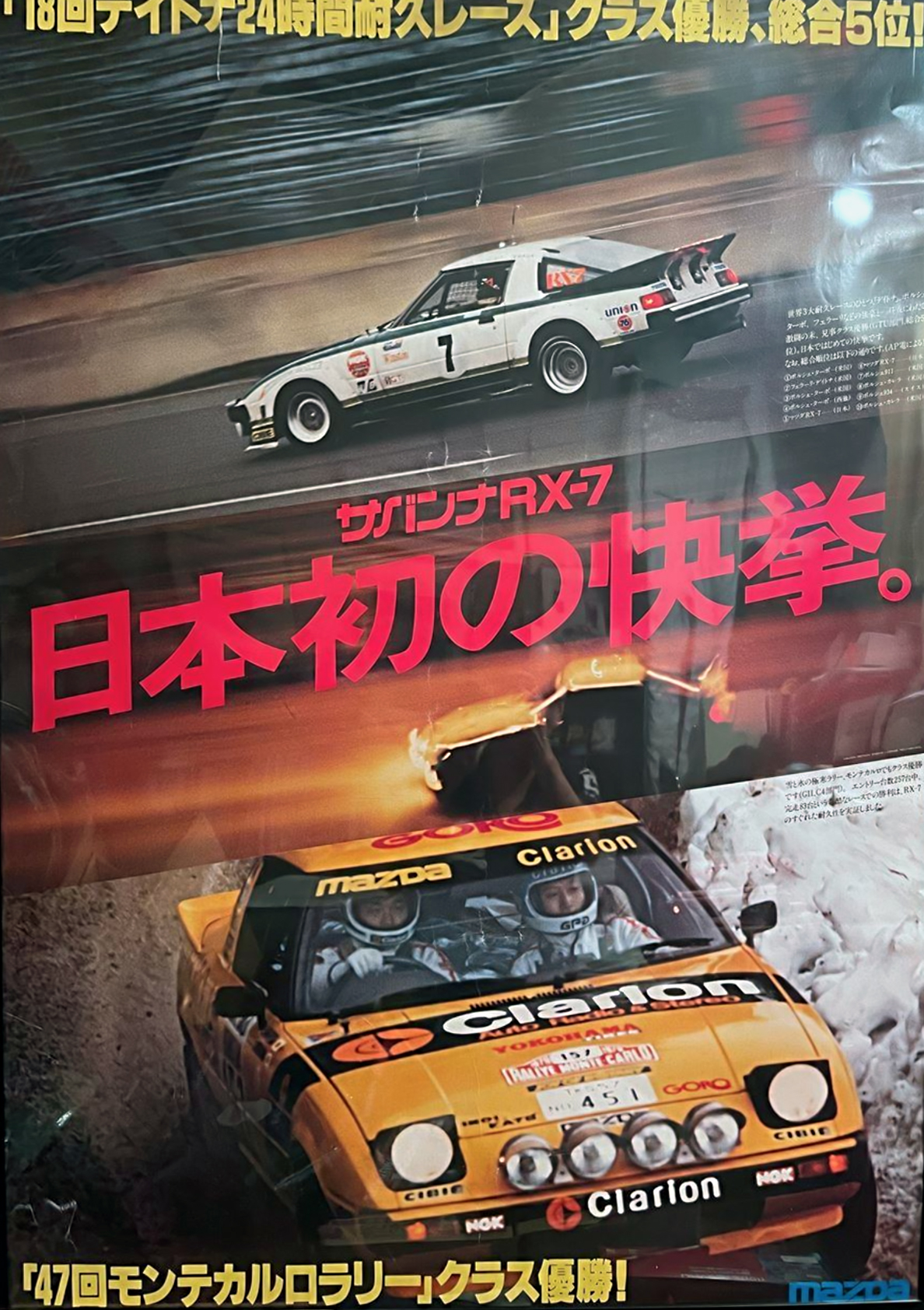
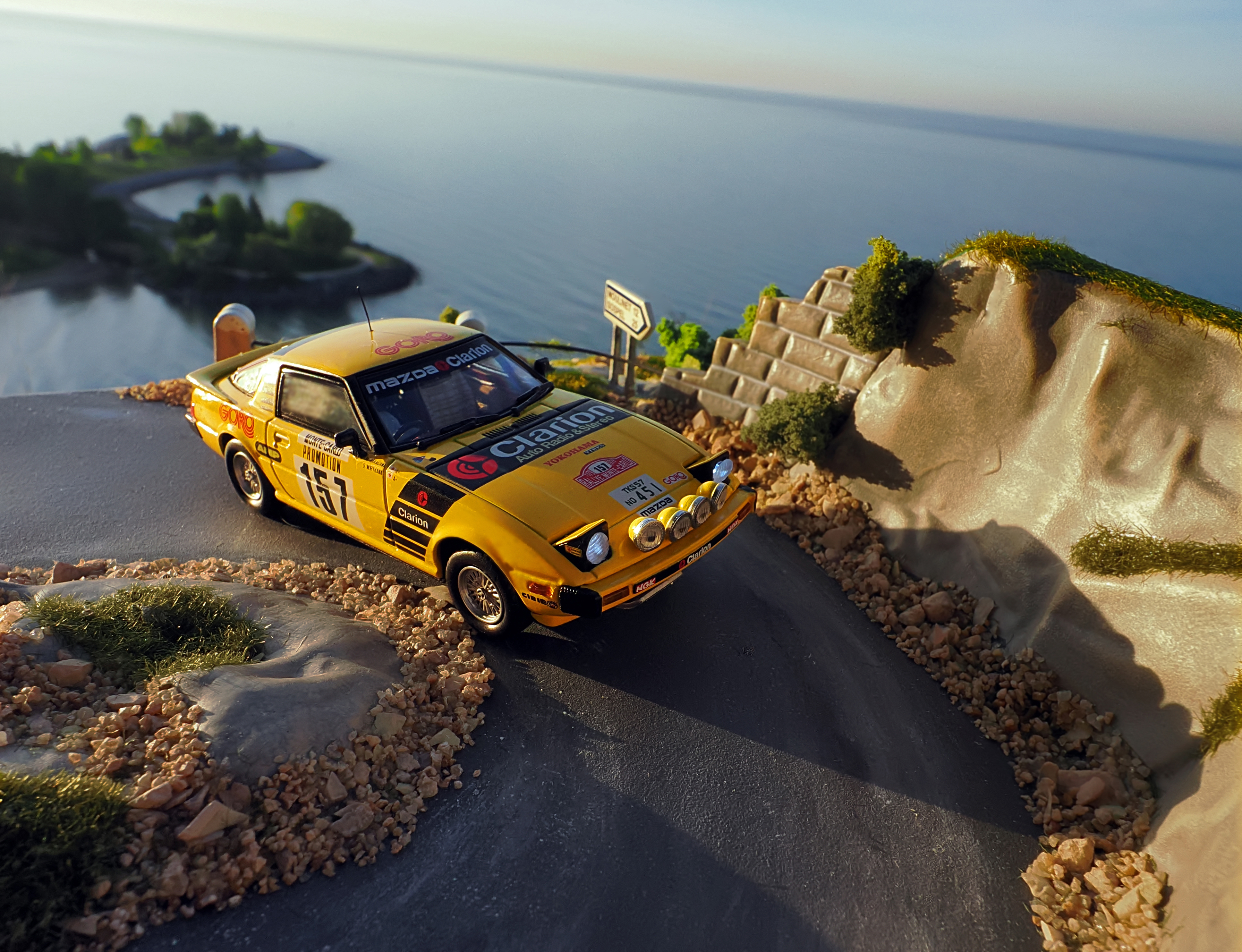
However Mazda really was the marketing winner here. For zero expenditure, they were able to promote both the Daytona winning Rx7 and the Monte Carlo Rally Rx7 on a poster that was displayed at all Mazda dealerships in Japan. If you look at the title graphic closely, the third image shows a sticker made by Clarion to commemorate the 1979 Monte Carlo Rally. Clarion sent a team of attractive women to Monte Carlo to hand out thousands of these stickers to spectators in their own marketing coup.#157 caught ascending the Col de Turini. AGAIN gotcha! 1:43 Kyosho diecast model shot on Monte Carlo diorama and over Lake Ontario at the Scarborough Bluffs in Toronto at sunrise.The Night of Long Knives
I am now past the age where I would participate in such a rally but for decades my friend and I entertained the idea of entering the Targa Newfoundland. Now my only real connection to this world is that I also own a set of those wonderful body moulded mudflaps, except I have all four of them!
I have degrees in Biochemistry and Dentistry and practice clinically 2 days a week. The rest of the week I devote to photography and bringing you the very best writing in this blog.
View all posts by jimchungblog



![01-03_Preben-Kristoffersen_Team-RMCH_12_[Kirketerp]](https://jimchungblog.com/wp-content/uploads/2024/05/01-03_preben-kristoffersen_team-rmch_12_kirketerp.jpg)




 Jim Chung's Ramblings