


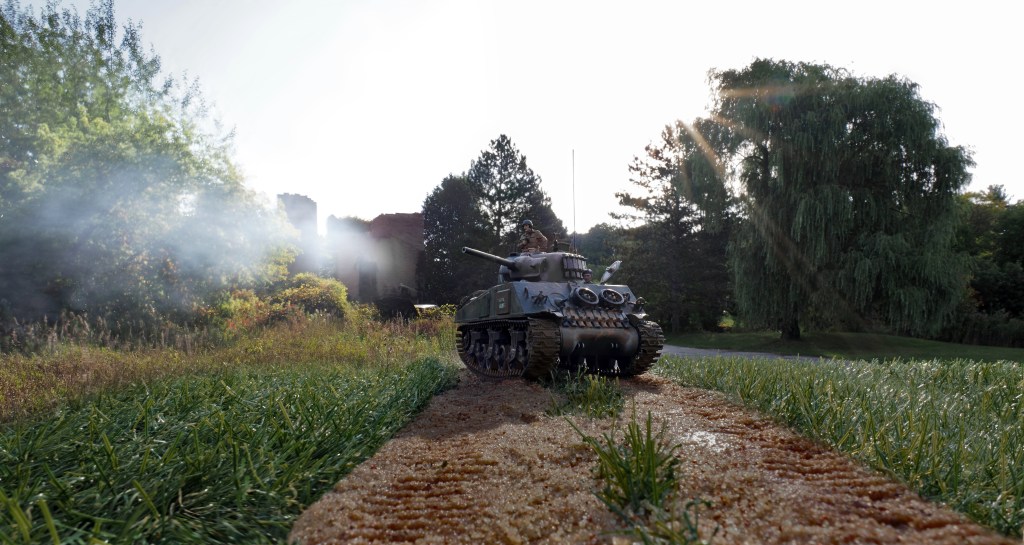
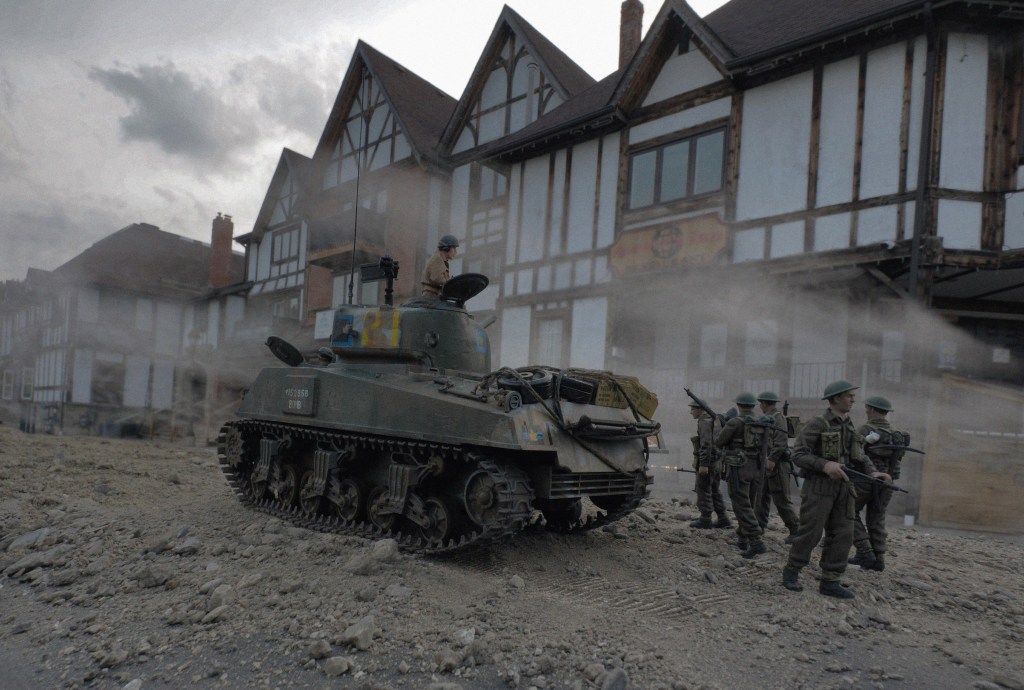
This is a story about a Canadian Sherman Tank that survived the war, fighting every day from D-Day until the capitulation of the Nazi regime.
Like many young boys of another generation, I spent my early years putting together plastic models and learning history at the same time. Somehow I gravitated towards making World War 2 tanks and with most of them being German ones. But I did make a Sherman tank and M13 Gun Motor Carriage half track. Even in scaled down plastic, the US armored vehicles did seem ungainly, less cool and less lethal than their German counterparts and I spent years with the false impression of superior German engineering, fabrication and the unmatched fighting prowess of its soldiers. I was a kid.
When Canada declared war against Nazi Germany in September 1939, she was woefully unprepared. The Army itself had 4200 permanent troops, 10 Bren guns, 5 mortars and 2 light tanks. The 1st Canadian Armoured Division was created from scratch but it was soon apparent that a second division would be needed and lacking the financial resources, the 4th Canadian Infantry Division was converted to the 4th Canadian Armoured Division and 2nd Canadian Army Tank Brigade. The Sherbrooke Fusiliers Regiment was attached to the 2nd Canadian Army Tank Brigade and consisted of three squadrons of tanks (A, B, & C) as well as additional tanks functioning as different levels of command HQs. There were recovery vehicles, Stuart light tanks for reconnaissance and upwards of 51 M4A2 Shermans with the standard short barrelled 75mm cannon and 21 upgraded Sherman Fireflys with the British 17lb 76mm antitank cannon. All tanks were extensively waterproofed to withstand wading ashore on D-Day in water as deep as 6 feet and towed large metal sleds carrying an extra 110 shells.
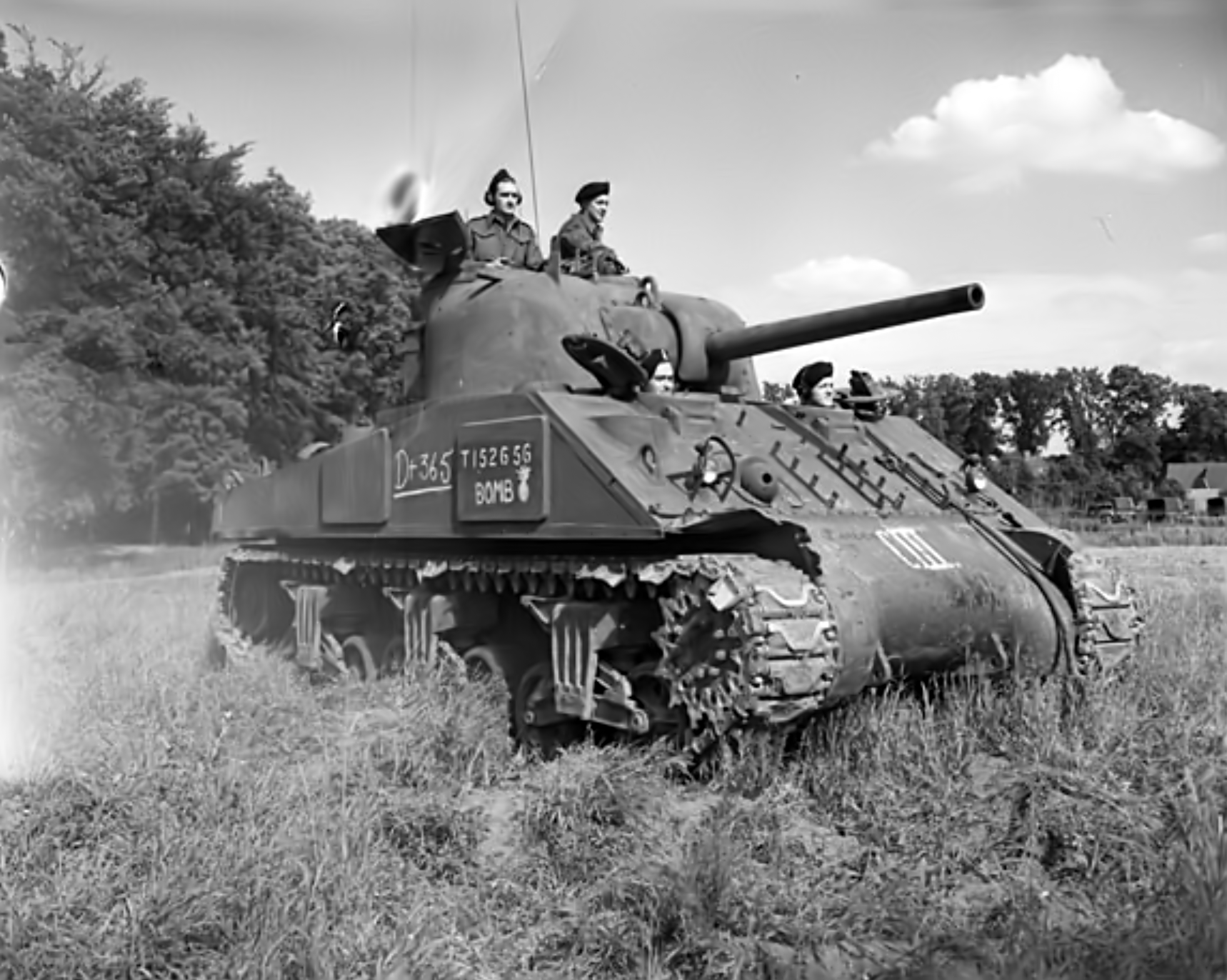
The tank crews had not slept for the previous 1-2 nights before D-Day as anxiety consumed them all. Fortunately, the landing proceeded without danger and after much delay the first tanks came ashore at 12:15 PM just west of Bernières-sur-Mer through only 3 feet of water. But the beach was a busy place, in fact a veritable traffic jam that took 6 hours to clear and proceed the short 3 miles inland to the staging area of Bény-sur-Mer. Only two holes had been blown through the 9 foot high seawall and all traffic had to be threaded through them alone. Meanwhile artillery was firing down the beach, naval fire was flying over their heads as well as endless sorties of fighters attacking targets of opportunity.
While Bomb and Squadron B hunkered down for the night just east of Basly, sporadic fire from smashed German units foreshadowed their approaching inland reinforcements determined to throw the Allies back into the sea. During a night sortie, Bomb came under fire from a German self propelled gun which was fortunately destroyed by a nearby British Sherman “mine clearing” Flail tank.
The next day, the Sherbrookes would be supporting the infantry of the North Nova Scotia Highlanders in taking the airfield at Carpiquet just outside of the city of Caen, their original and very ambitious D-Day objective. They made good progress towards their target in the morning but lurking to counterattack was the 12th SS Panzer Division comprised of Mark IV and Panther tanks and fanatical 18 year old Hitler Youth trained and backed by highly experienced NCOs who were veterans of the Russian front. The Canadians were hit hard on their flanks in the early afternoon and outnumbered but Canadian artillery and naval fire saved the day and they more or less held their positions but were denied their goal. The Sherbrookes lost 28 tanks with only 24 fit for action but another seven could be repaired. The North Novas were more severely mauled with Company sized groups fighting to the last man while trapped in small villages or surrendering when out of ammunition. 37 Canadians captured were interrogated and executed by the 12th SS and buried in mass graves with two of them having their bodies repeatedly run over by tanks until their remains were embedded into the street surface. Similar atrocities would be repeated by the Hitler Youth over the next few days with captured Canadians. The intense tank battles continued the next day and enemy kills rose to 41 tanks, two attributed to Bomb. Only 5 tanks from Squadron B survived, including Bomb, and the Sherbrookes were relieved by the First Hussars and the Fort Gary Horse – the other two regiments of the 2nd Canadian Army Brigade.
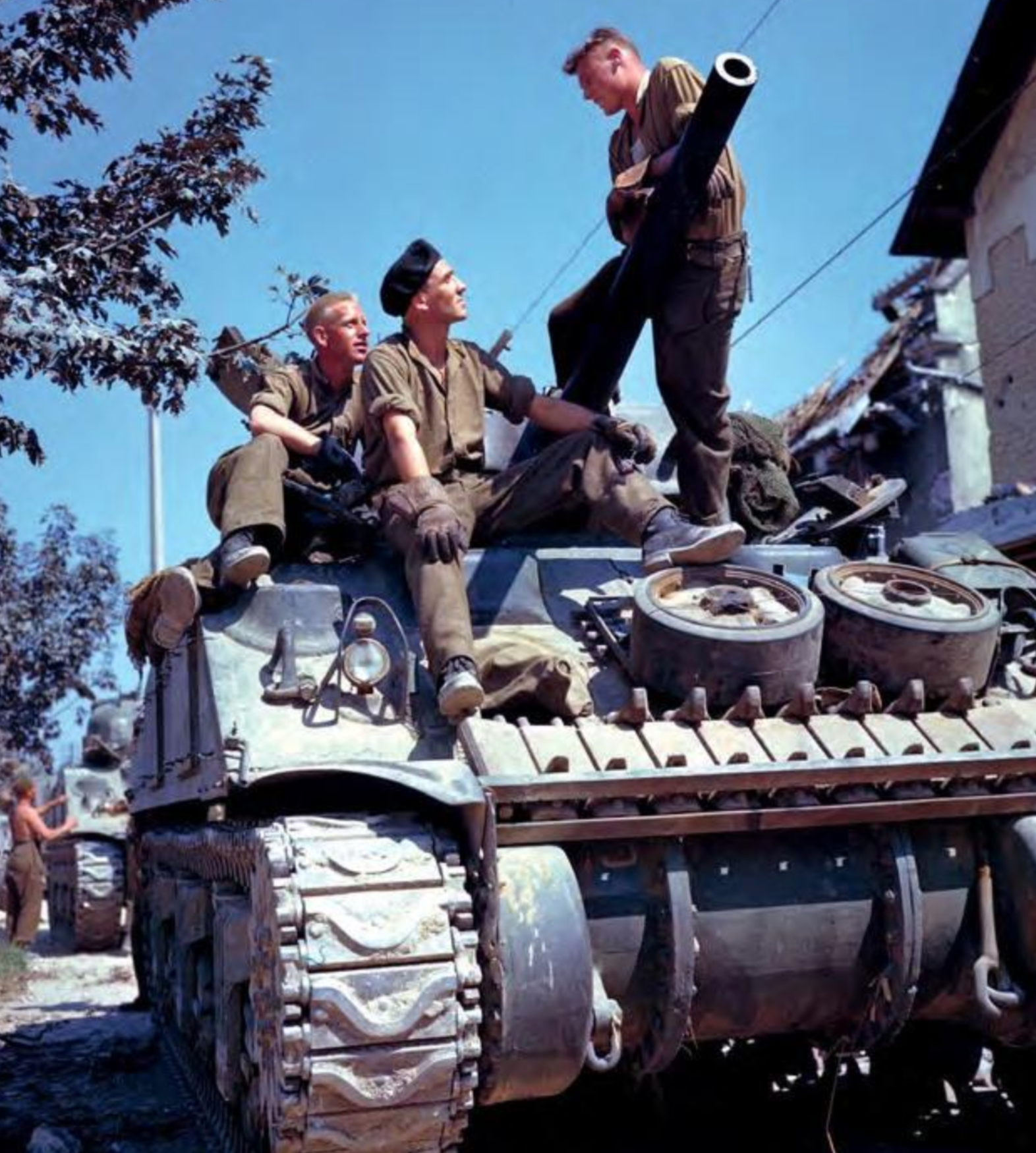
Even when the factory upgraded 76mm gun was available to the Shermans, many crews declined it because the high explosive round of the 75mm was much more effective than the one for the 76mm. In the field, the HE round is what counts in taking out infantry and crews manning antitank guns and AP (armor piercing) rounds are only relevant with tank on tank encounters, which as the war wore on became less and less frequent. Shermans were also designed to be very easy to service in the field, just look at the exposed idler wheels and easy to exchange bogies compared to the German suspension with internal torsion bars and interleaved road wheels which are very difficult to disassemble and replace. The initial use of an upright aircooled aircraft based radial engine meant that the engine compartment and the tank itself had to be tall in profile but this also increased cabin space for the crew and extra comfort as well as easier and quicker escape by the crew. In this manner many Canadian crews survived their tank’s destruction.
The British and Canadian goal of taking Caen was stalled by mid June and resupply delayed by bad storms along the coast. They faced seven of the eight German Panzer divisions and six of the 12 Panzergrenadier divisions freeing the American armoured units to conduct a broad sweep on their right flank and threaten to cutoff the German retreat path. The recovered but understrength Sherbrookes were attached to the 27th British Armoured Brigade and faced the largest German armour formation by the end of June boasting 79 Panthers, 79 Mark IVs, 76 StuG IIIs and 30,000 men. Hitler had personally visited the front and ordered that the port of Cherbourg be recaptured and split the Allied beachhead. Withdrawal and retreat was not permitted. After weeks of combat the Allies were finally on the cusp of entering Caen in the second week of July.
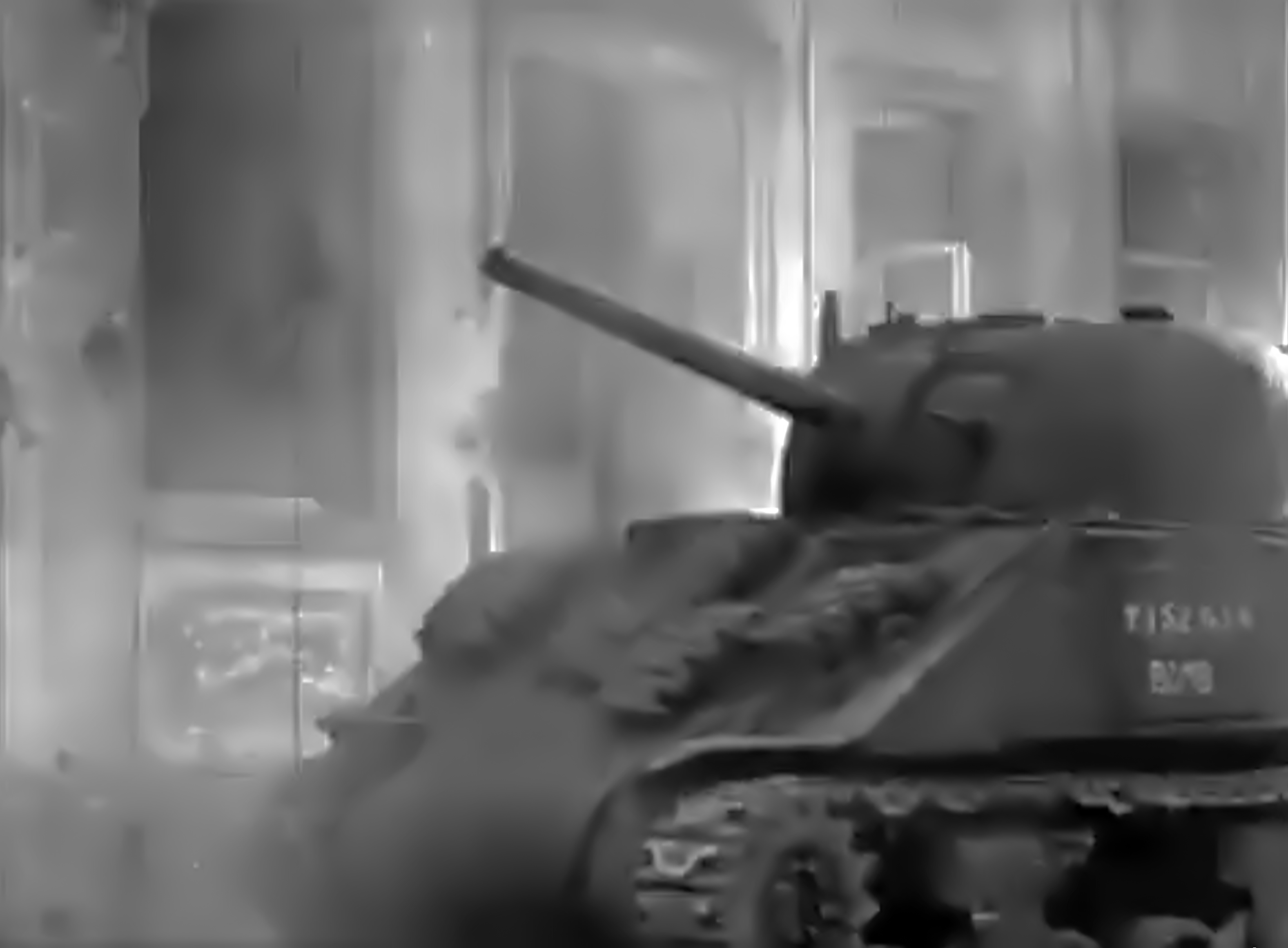
The infantry of the Stormont, Dundas & Glengarry Highlanders (SD&GH) from Cornwall, ON were supported by the Sherbrookes as they made their way into Caen on the morning of July 9th. As they traversed a recently cleared minefield, a German 88mm antitank gun fired an AP round at Bomb but it only hit the breech of the .50-cal Browning antiaircraft machine gun mounted on the top of the turret but the fragments wounded tank commander Sgt. Harold Futter (Rapid Blanc La Tuquo, Québec) and co-driver Trooper James Fletcher (North Timmins, ON) and cut the leads to the radio set. A smoke screen was instantly laid down. At 1:30 PM, the SD&GH signalled that they were in Caen.


The crew of the Bomb remained relatively intact with changes in command. In no specific order the driver was Lance Corporal Rudy Moreault of Montréal, gunner was Trooper A.W. Rudolph of Claresholm, Alberta and Trooper J.W. Hall of Crescent, BC was loader. Fitz the dog was likely the Troop or Squadron mascot.
Bomb and now once again the last three remaining tanks of Squadron B tried to find their objective which was the church of Saint Étienne-le-Vieux but only found scared citizens hiding in the caves along the Orne River. On hearing the French spoken by the Sherbrookes, the overjoyed civilian populace emerged from hiding with grateful tears and kisses. In return, the tank crews gave them cigarettes, chocolates and candy. By the end of the day, the Canadians were firmly established in Caen with only a few small remaining pockets of resistance. The regiment withdrew on July 11th to repair and reequip and also enjoy a shower and a change of clothes from the Mobile Laundry and Bath Unit. Trooper Ken Campbell of Burns Lake, BC came on as the new codriver and Lt. P.W. Ayriss became the new tank commander.
The Germans had lost more than 100,000 men and there was precious little left from the Eastern Front to replace these losses. They proceeded to dig in on the high ground 5 miles south of Caen. On July 18th, three British armoured divisions probed the German positions that had been bombed by both the RAF and the USAAF but had to cross open and exposed ground. Unfortunately the Panzer units had survived and resulted in nearly the loss of 200 tanks and very light German losses. But the Allies could easily afford to replace these losses and many damaged tanks could be recovered and repaired. The German High Command already knew the war had been lost in the face of this logistical juggernaut. On July 22nd, Squadron B was across the Orne River and south of St. André-sur-Orne hiding in an orchard when the Germans launched an infantry attack supported by tanks. After an exchange of fire that lasted only 30 minutes, 15 Germans tanks destroyed with Bomb claiming two of the kills. A follow up German attack was repulsed and Squadron B reported having a field day shooting up unprotected German infantry. Although the Brits had failed to take Bourguébus Ridge and the Canadians had also failed to seize Verrières Ridge, Monty felt the strategy was working. Although the combined British/Canadian loss of tanks was over 300 (with more than 50% recoverable), the Germans had lost over a hundred tanks and had committed their last reserves. In the future they would not be able to defend theirs positions with as much vigor. The Second British Army faced fourteen German divisions. The Canadians faced off the elite I.SS Panzerkorps while the 19 American divisions faced only nine German divisions.
By August 1st, the Americans had broken through the German left wing and was making rapid progress in encircling the enemy between them and the Brits and Canadians. Monty ordered the First Canadian Army to attack towards the town of Falaise in an attempt to meet up with the Americans and trap the entire German Army within. Canadians have always been good at innovating and adapting on the battlefield. The German front was well entrenched with antitank guns and it was decided that they would attack at night using heavy bombers as cover. Previous attacks had come at heavy cost to the infantry so 105mm howitzer self propelled guns known as Priests had their guns removed and armor plating added to the chassis to become the world’s first armoured personnel carrier and were referred to as Kangaroos or defrocked Priests! Each infantry division was given 30 to carry their troops. Navigation in the dark would be difficult so targets were kept illuminated by bouncing searchlights off clouds, firing sporadically at them with the 40mm Bofors and using a tight radio beam such that the troop leader’s tank would hear a signal if he strayed off target.
Just before midnight on August 6th, over a thousand Halifax and Lancaster bombers dropped 3500 tons of bombs followed by a creeping artillery barrage just in front of the advancing tank columns. The dust created by all the exploding ordinance and the retaliatory German smoke screen rendered the spotlight and tracers from the Bofors useless but the tight directional radio beam was able to guide Squadron B with Bomb and the Royal Hamilton Light Infantry on target until they crested the first hill. The Germans were caught completely off guard running around in their underwear as the Canadians drove right through their camp and took them all prisoners without firing a shot. They reached their objective finding it held by the enemy with four tanks and the feared Jagdpanther. Squadron B engaged and drove off the attacking force destroying four German armoured cars while losing one Sherman and one M10 tank destroyer.
By Noon of August 7th, most Canadians and British battalions had made their objectives and the result was a broken and demoralized German 89th Infanterie-Division and a 4 mile wide gap in the German lines. Seven hundred B-17 bombers of the USAAF dropped their payloads on the surrounding towns as scheduled to further drive home the point. If you have air superiority, take every opportunity to rub your enemy’s nose in it.
The German command realized it needed to stabilize the front quickly or risk losing mulitple tank units as they became cut off from resupply and infantry support. Famed tank ace SS-Hauptsturmführer Michael Wittmann with over a hundred credited kills to his name led a column of five lethal Tiger 1s accompanied by two other Tigers, a number of Mark IVs, halftracks and a Jagdpanther travelling on the opposing side of the highway to stop the Canadian advance. Squadron A had reached the town of La Jalousie and had 10-12 tanks (including 2 Fireflys) occupying the estate of a large chateau with a tall stone wall that encircled it. They had punched holes through the wall and could easily observe the traffic approaching from the SE. They held fire until 500 yards and the first shot penetrated Whittmann’s lead Tiger setting off its ammunition and blowing the entire turret off the tank. The British on the opposite side of the road also engaged and the entire column was eradicated.
On the morning of the August 9th while fending off a series of heavy German counterattacks, Squadron B had been placed in support of 4th Brigade in an observation role. A German Mark IV hit the front glacis plate of Bomb and the crew fearing a follow up coup de grâce, bailed out. The Mark IV in turn was immediately destroyed by another Allied tank and Bomb’s crew returned to the still idling tank to inspect the damage. The shell had not penetrated the armour because it had hit a spare bogey wheel mounted on the tank and been deflected!
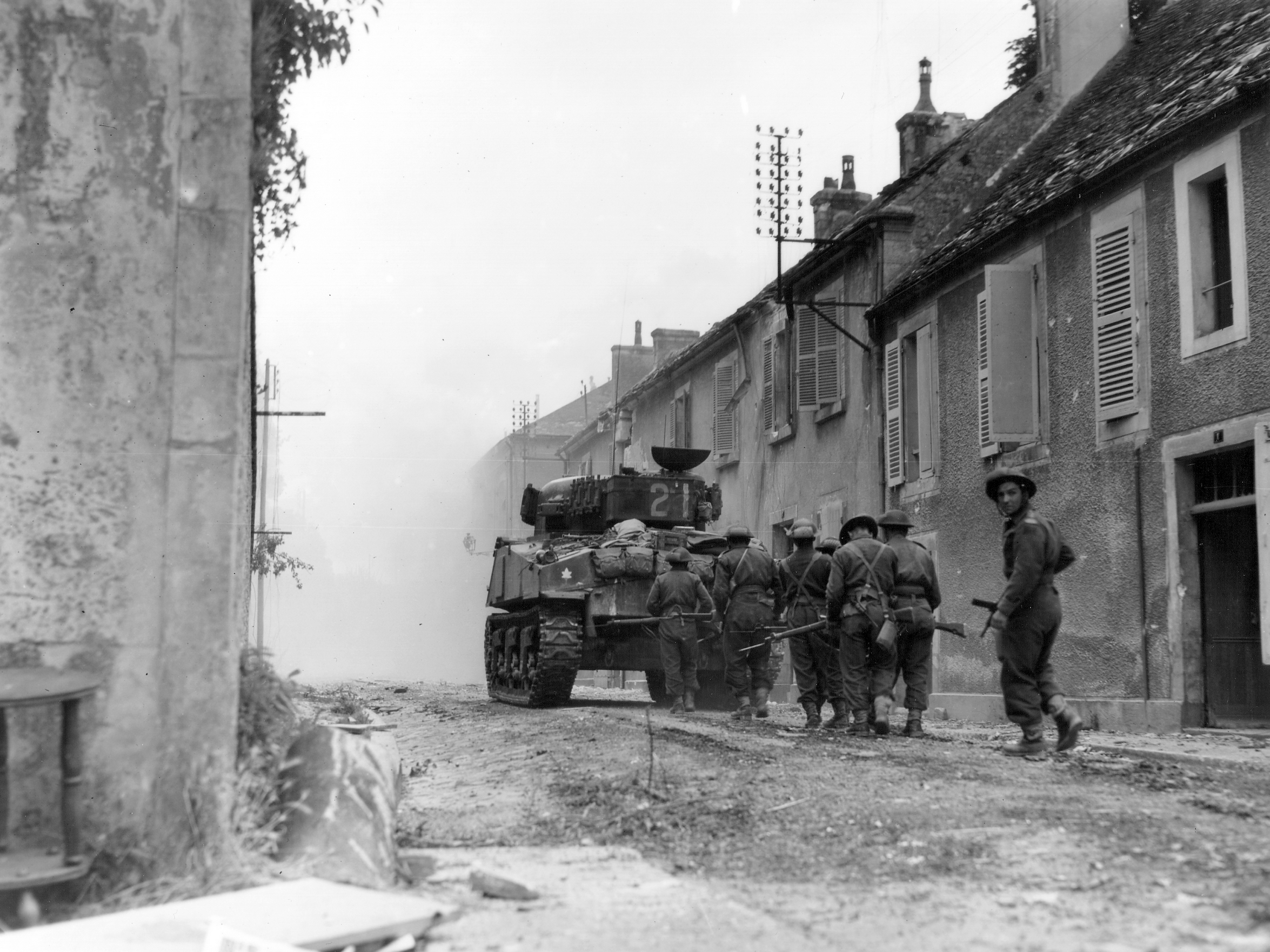
The first two lines of German defense had been breached and the use of APCs had resulted in far fewer casualties with a gain of 10 miles towards Falaise. But the momentum had been squandered when Second Canadian Corps had halted to await a scheduled air bombardment and the Germans had time to reorganize their defenses. Even German command conceded the Canadians could have broken through and driven all the way to Falaise on August 7th if not for the failure of the two Canadian armoured divisions. The green Canadian armoured regimental commanders were berated for their lack of aggression and drive, the need to push to the very limits of endurance and the ability to maneuver at night.
On August 10th, Patton’s Third US Army was to head north from the Le Mans area to make contact with the First Canadian Army driving south to Falaise. The Germans would fight an inspired rearguard action because Falaise had the only good road for the encircled German forces to retreat. For more details you can read my other blog entry on this subject: https://jimchungblog.com/2023/08/25/the-most-famous-canadian-photo-of-world-war-2/. On August 14th the 6th Brigade crossed the Laize River to seize a new bridgehead and the Sherbrooke tanks found themselves a mile from Ussy supporting the Cameron Highlanders of Ottawa and the South Saskatchewan Regiment against weak German counterattacks. At 15:00 RAF bombers began dropping on the river valley immediately to their front but despite yellow smoke signalling the position of friendly forces, bombs fell on the South Saskatchewans killing over a hundred along with a near miss on Bomb. The terrain was now speckled with 30 ft deep craters some 40 ft wide.
The desperate Germans were looking for an alternate route to escape the Allied encirclement and attacked east to break through Canadian positions between Chambois and Saint Lambert-sur-Dive. The Canadians in response used their infantry and tanks to repel the German attacks and when a sizeable force had accumulated would call in the Typhoon ground attack fighters which would strafe, rocket strike or bomb the exposed and doomed German forces to oblivion. A sizeable number of German soldiers did escape the Falaise pocket but half a million were killed or taken prisoner. The despised 12th SS-Panzerdivision went from an operating strength of 21,000 men to … 60. The material losses were just as unreplaceable by German industry. This was the end of the Normandy campaign.
This is just the first half of Bomb’s adventure. Stayed tuned for its latter exploits.


 Jim Chung's Ramblings