


During critical periods throughout World War 2, Hitler would be hesitant and unable to decide on a course of action, despite the pleadings of his staff. Rommel was now deep into Egypt and only 100 km outside of Alexandria. Less than 500 km to the Suez Canal. The British had lost 80% of their tank force. Mussolini implored Hitler to invade Malta now because her defences were only getting stronger and even after 5 months of continuous bombing, Malta was still able to sink on average an Italian transport every day.
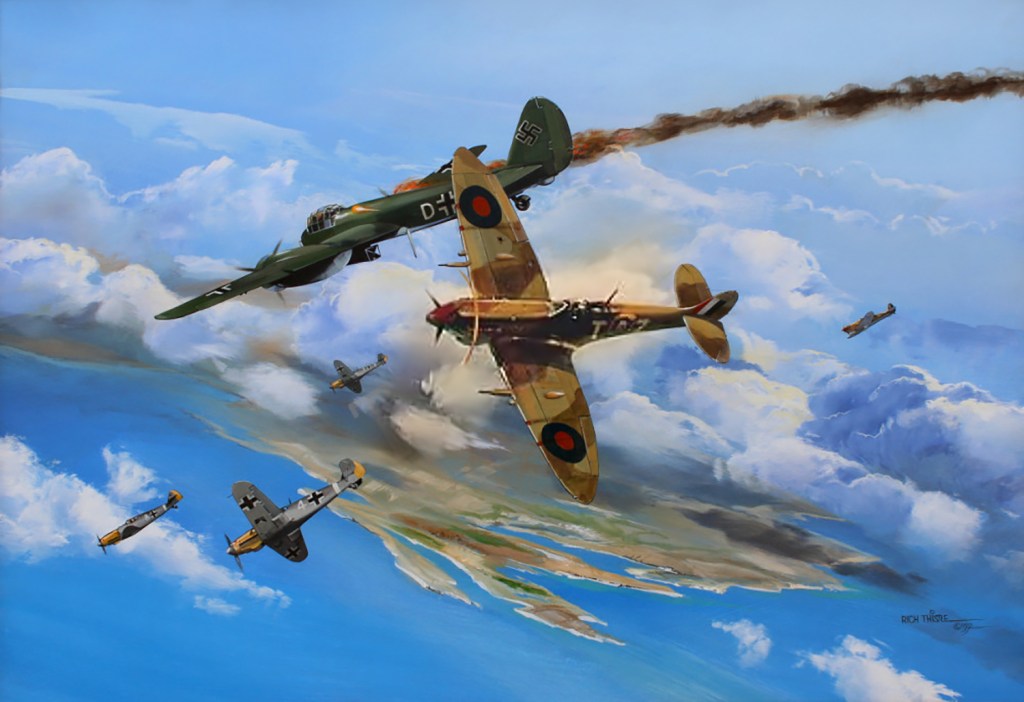
On June 3rd, the Eagle surprised herself with a stupendous launching of 31 Spitfires to Malta. Since attacking them on landing wasn’t working, the Germans decided to intercept them midflight and provoke them into combat to use up their narrow fuel reserves.
Wally MacLeod, from Regina SK, was jumped by 12 Bf-109s coming right out of the Sun at midway to Malta. Luckily they were all bad shooters and he managed to shake them all off his tail. Four Spitfires did get shot down but none ran out of fuel. As they approached Malta, MacLeod radioed for directions and a German operator speaking perfect English responded but gave him the wrong coordinates. But MacLeod was destined for greatness and felt something was off and continued on course via compass navigation and landed his men safely.
The 26 year old MacLeod was older than fellow pilots and well educated. But he had been raised in extreme poverty during the Great Depression and had lost his mother early. When the RCAF offered him better prospectives, he quickly joined up and was well on his way to becoming a deadly fighter pilot with the attitude and burning ambition to become Canada’s top ace. The very next day he downed a Cant but failed to detect the Macchi that came up behind him and put a dozen bullet holes into his Spitfire. Fortunately for MacLeod, the Maachi was an excellent plane but insufficiently armed because it lacked cannons. MacLeod saw the fate that could’ve been his as he observed a fellow Spitfire pour cannon shells into another Maachi causing the aircraft to explode and expel its unfortunate pilot into space with his parachute aflame, to plunge 5 long kilometres to certain death.
Failing to convince Hitler to invade now, the Luftwaffe had no choice but to completely erase the RAF presence from Malta. Shortly after dawn, English pilot Laddie Lucas and Canadian Frank Jones teamed up to shoot down three Ju88s low over the water. Fellow Canadians Ozzie Linton and Basil Butler sent another Ju88 down moments later. Five Cant bombers showed up with 40 Macchi and Reggiane fighters enroute to bomb the harbour. Two Cants were blown out of the sky and the only casualty was Wally MacLeod who had his engine blown apart by accurate fire from a Cant side gunner. As he glided back down to Earth, Wally realized this was the second time in only three days that the Italians had destroyed his plane. After a day with no losses and nine enemies shot down, two Spitfires were lost two days later
Then on June 9th, Sergeant Pilot George Beurling from Montréal arrived on Malta. George knew he wanted to fly at a very young age and obtained his wings at age 16. He dropped out of high school and when he tried to join the RCAF but they wouldn’t have him, particularly for not even completing Algebra². He tried to join the AVG and fly for Nationalist China against the Japanese. He tried to join the Finns to fly against the Russians. Finally the RAF accepted him but he had to brave the German U-Boats again and cross the Atlantic to get his birth certificate. He was determined, but not good with authority or taking orders which might be a result of a traumatic childhood spent with parents belonging to the deeply religious Plymouth Brethren who believe that the personal study of the Bible is the sole determinant for religious practice. He was however a gifted fighter pilot and quickly shot down two FW-190s over France. When he volunteered to go to Malta in place of a married pilot, No. 403 Squadron were happy to be rid of him.
On June 12th, Beurling blew off the tail of a Bf-109 while Bucky McNair also shot down another Bf-109, whose pilot bailed out and was rescued by a Luftwaffe flying boat.
Churchill attempted to attack the Malta resupply problem from both directions. He was sending large convoys from Gibraltar and from Egypt. Six transports including an oil tanker were escorted by 10 RN destroyers and followed by two aircraft carriers and a battleship would steam East. Steaming West were 11 transports and 20 naval vessels. In total there would be enough food, fuel and ammunition to last into the autumn. Nine British subs would also be present to sink any opposition. The Western bound convoy encountered the Luftwaffe planes based in Crete which sunk two transports and three destroyers. A U-boat than sank a RN cruiser with all hands lost and then the approach of a capital Italian fleet made the convoy turn back home. Italian torpedo boats and the Regia Aeronautica sank two destroyers off Sardinia in the other convoy. Another air attack of Stukas and Cants sank three transports the next day and would have sank them all if not for the intervention of the Malta aircraft flying with long range tanks. Two merchantmen and two destroyers finally crawled into the Malta harbour.
On June 20th, Rommel captured Tobruk, 25,000 British soldiers and hundreds of tonnes of supplies. He felt he now had enough ammunition and fuel to drive straight to the Suez Canal. Hitler agreed. Others cautioned Rommel to wait until Malta fell.
By the end of the month, 71 enemy planes had been shot down all for the loss of 25 of their own.

But the war of attrition continued to be won by the Axis forces since even if they lost more planes, they always had more to replace their losses. As the week passed and Beurling dealt with the enemy fighters while his comrades continue to kill Ju88s, Doglio Niclot racked up six Spitfire kills since the beginning of the month.
On July 12th Beurling shot down three Maachis including a long report describing closing on Aldo Quarantotti from the portside at 35 yards and being able to see the cannon shells blow his head right off and the slipstream catch the large volume of ejected blood to deliver it down the side of the white fuselage. While this might sound callous, he was reacting to people who had killed his friends and comrades and later in life he was so haunted by nightmares of this particular death that he would cry all night. With 12 kills, he was awarded the DFM but refused to accept a commission, being more comfortable interacting with the enlisted men.
Meanwhile Dolio shot a pair of Spitfires out of the sky giving him nine. Still Malta was losing Spitfires on a daily basis requiring a new contingent of 32 pilots and Spitfires from the Eagle on July 15th.

The death of Niclot hit the Regia Aeronautica hard. Pilots thought that if he couldn’t survive, how could they? Similarly the Luftwaffe was having doubts of ever taking Malta when 49-kill ace Siegfried Freytag had also been shot down although he had been able to bail out and be rescued by German seaplane. Three Ju88s had gone down that day, and three more the next day.
Beurling ended the month with 16 kills for a total of 18 in the war. His commission was forced upon him. The Axis had shot down 50 Spitfires but lost 137 planes of their own. And with another late month Eagle delivery of 28 new fighters, Malta end up with a zero net loss for the month.
Combat stress, starvation and disease began taking their tolls on the pilots. Four Spitfires went down with no reprisals in the first week of August. Beurling dragged himself out of bed and led an attack coming home with one Bf-109 kill before three of them jumped him and he crash landed into a farmer’s field only to blithely hitch hike a ride back to base.
The next day brought three more kills including one by Wally MacLeod. He saw the Bf-109 pilot bail out and and land in the sea but strangely did not inflate his one man dinghy. Thinking that perhaps it was defective, MacLeod circled over the man and dropped his own raft. The German pilot looked up and waved his thanks but still made no attempt to climb on board MacLeod’s now automatically inflated raft. When the rescue launch reached him, they discovered one of the cannon shells had gone through his chest and the German pilot was just waiting for death which arrived before he got back to shore.
Jerry Smith from Regina was chasing a Ju88 out to sea at dusk and was seen shooting it down for a 4th kill, but he never returned. Perhaps he had been gravely injured from the bomber’s return fire. He had just be reunited with his brother Rod who had shown up on Malta two weeks earlier and the two had begun flying together.
British High Command decided it had to stabilize the food and supply situation in Malta once and for all and organized a massive convoy with 13 transports and one oil tanker (the Ohio) to be escorted from Gibraltar by four aircraft carries, two battleships, seven cruisers, 24 destroyers and 4 corvettes.

An Italian submarine sunk a cruiser, damaged another warship and put a torpedo into the Ohio but she was able to continue sailing. Then the three remaining aircraft carriers had to return home leaving the convoy with no air cover. Enemy air attacks and motor torpedo boats sank seven merchantmen and two more RN warships. The battleships turned away approaching Italian cruisers after damaging two of them. Four damaged merchantmen made it to Malta followed later by a badly injured Ohio which had to be towed into harbour but she did deliver her 12,000 tonnes of oil before sinking at her berth. Malta now had sufficient food and supplies to last past October, but more than 500 Allied sailors and merchant marine died in the action.
It had been a grievous mistake not to sink the Ohio. Then on August 17th, 30 more Spitfires were delivered giving Malta more than 100 operational fighters to defend herself. Instead of increasing the pressure, the Luftwaffe suddenly eased up on their attacks. After an entire quiet week, Malta began to launch attacks against their Sicilian airfields and increased their success sinking transports. Two were sunk by Malta bombers and a third by Malta based submarine. Then another sinking two days later. Rommel had been counting on these supplies for his new offensive and now he was stalled.
Finally the enemy began showing up on Sept 15th. The next day Beurling and English pilot Eric Hetherington fought for their lives for over an hour against 8 Bf-109s before the Germans gave up and returned home. On Sept 25th, Beurling and nine Spitfires tangled with a dozen Bf-109s. He shot one down in flames and damaged a second. Seconds later he saved British pilot Ernie Budd by blasting a Bf-109 off his tail but the unfortunate German pilot bailed out and was cut in half by one of his fellow German pilots mistaking him for a British pilot descending in a parachute. Beurling was so sickened by the cruel sight that he almost vomited into his oxygen mask. Beurling was now at 20 confirmed kills and many other possible kills.
Malta’s bomber crews were also busy sinking 11 transports in the month alone and really aggravating Rommel and his plans.
On October 11th, Rod Smith was amongst the first to glimpse the largest attack sortie organized by their enemy. Smith went for one of the Ju88 bombers while evading the defending Bf-109s and set both engines on fire before it blew up in half. So numerous were the raids that Wally McLeod got 3 kills in 48 hours. On October 13th, Beurling attacked a Ju88 and then shot down two Bf-109s coming to its rescue. He then spied a Ju88 dropping its payload on an innocent village and in anger chased the retreating bomber well out to sea before catching it and sending it into the water with two bursts. Beurling now had 3 kills and one damaged all within 10 minutes.

Over the next two days Canadian John McElroy would be shot down and finish with 10 kills. Rod Smith also survived bailing out over the sea. Wally MacLeod got two further kills over the same period raising him to 13 kills. The enemy had lost 132 planes in October and their pilots were on the verge of full revolt. By November 7th, the Luftwaffe capitulated and scaled back operations. Resupply convoys entered Malta without resistance. Bomber missions departing Malta increased and by the Spring of 1943 were literally starving Rommel and his army to death. By May of 1943 a quarter million German and Italian soldiers were captured and Rommel had departed North Africa along with his plans of conquest.
This marked a turning point of the war such that the fortunes of Nazi Germany began to reverse and they began a slow retreat on all fronts.
.
.
.
² This is personal vindication. I have always said Algebra, Trig, and Calculus are important math courses in highschool – no matter what you do in life. Especially life in the 21st century.

 Jim Chung's Ramblings