


It took years of post war debate and research to finally credit the kill of famed Nazi Tank Ace Michael Wittman to Major Radley-Walters, who was the officer commanding A Squadron of the Sherbrooke Fusiliers, a regiment of Canadian Sherman Tanks during World War 2.
I long wanted to write this blog about his exploits having read his obituary in 2015, but little exists in print about the man. Despite holding the Allied record of 18 enemy tank kills and the destruction of numerous lightly armoured vehicles and towed artillery pieces and an ostensibly beatific and highly decorated combat war record, the man left no memoirs. There exists a good two part condensed life story supplemented with insightful interview passages from the 2012 Canadian Military Journal but little more. I finally connected with retired Lt Colonel Larry Zaporzan, himself an armoured officer, who had written a Master’s Thesis on the very subject in 2001 for his degree from the University of New Brunswick. I was nearly resigned to visiting Canada’s National Archives in Ottawa and spending all day reading an uncirculated copy when he most kindly emailed me his digital draft. Thanks Larry, I hope you approve of my summation and my desire that more Canadians learn about their proud military heritage as events south of us continue to both dismay and concern.
Major Rad, as he was fondly addressed by his men, was a native son of the Gaspé Peninsula and graduated with a Bachelor’s Degree in Science from Bishop’s University in 1940 with the original intent of becoming either a medical doctor or a forestry engineer. But everyone could see the storm clouds gathering over Europe and he also enrolled in the Canadian Officer Training Corps which was affiliated with the 35th Battery, Royal Canadian Artillery in Sherbrooke. He learned to be an artillery officer practising on vintage Great War pieces. With the onset of hostilities, the nation created and mobilized new units and he joined the local and newly formed Sherbrooke Fusiliers, an infantry regiment, as a 2nd Lieutenant.
Canada was woefully unprepared for WW2, and would continue to be throughout the war, but perhaps this is the price that has to be paid by peace loving countries. We have no designs on expansion or empire building and there is certainly a heavy economic penalty for a country to maintain large and active military forces even in peacetime. But the men had no uniforms. And when they finally materialized, they were missing crucial unit identification badges, shoulder flashes and collar dogs that would allow the men to meld and identify as belonging to a distinct fighting force. In battle, men fight for their brothers in arms before fighting for God, King, Country or even family. And then came the ridiculous necessity of training with one Bren machine gun and six M36 grenades for each platoon of 36 men. Officers would attend training in the evenings and hastily prepare deep into the night in order to be ready to teach the next chapter of infantry tactics to their men the next morning. But at least they all became incredibly fit marching 10-25 miles daily and by May 1941 each soldier was finally laden down with a full kit of equipment to carry.
In January 1942, the regiment was renamed the 27th Armoured Regiment and would transition from infantry to a tank force. The old but experienced World War One NCOs and officers had been instrumental in forming the Fusiliers but were teaching outdated ideas like communications based on written messages carried by runners. High command knew that this would be a mobile and modern war that required young men with bright minds. A tremendous culling at all levels ensued and those that failed to qualify were dispersed to other infantry battalions.
Tanks, artillery and infantry were intimately used to support each other and Rad was in the unusual position to be well informed in each of these elements and hence how best to utilize them when needed. With the establishment of Allied air dominance by D-Day, air strikes could potentially also be called in to eliminate resistant enemy positions.
By November 1942, the Sherbrookes were in the UK to further their tank training but once again equipment was lacking. The barracks appeared to have been constructed for 18th century cavalry troops and tanks were simulated with …. fence rails. The men did undergo intense instructions in wireless operation, driving and tank maintenance and gunnery but without real tanks it made practising tank movement tactics difficult.
Still training was a serious endeavour because people die during training. Rad was umpiring an exercise travelling on a motorcycle accompanied by a Corporal astride another motorcycle. A number of Churchill tanks were attempting to climb a steep paved road but the temperatures were below freezing and they began to slide down the road sideways and out of control. Rad threw down the motorcycle and rolled into the ditch but the Corporal was too slow and was hit and run over by two tanks. When Rad ran over to him, his legs had been torn from his torso and the man was still fully conscious and politely asked Rad to remove a photo of his English girlfriend from his wallet so his wife would never know. He died a minute later.
Similarly, Rad was promoted to Captain and later assumed command of C squadron’s 15 tanks when the commanding officer who was a Major was injured by being crushed between two tanks in another exercise and took leave.
By the summer of 1943, they finally received enough Canadian made Ram tanks to begin live fire exercises where artillery fired real ammunition barrages and the tank and infantry units would closely follow behind it as the barrages moved forward. But many tank commanders still did not understand how the three elements worked in unison where the tank at certain times were providing the support and at others were being supported. Tank commanders were trained to rely on Forward Observation Officers (FOO) to call down fire and to also report corrections to the artillery. In the heat of battle one did not have the time to follow the protocol if even the FOO was still alive. Rad likely saved his men time and time again by calling in artillery fire right on top of his position, corrections and all.
Rad recalled in particular a course on AFV (armoured fighting vehicle) Recognition. He was trained to recognize all types of tanks when camouflaged or when only pieces of it were exposed, even if it was just a fender, a cannon muzzle brake, or a wheel. In tank on tank combat, generally the first tank to aim and fire is the ultimate victor and Rad’s ability to see things nobody else could see became legendary.
The Sherbrookes had now spent two years in tank training and were technically proficient but Rad had little actual instruction on being a leader of men. He determined that if he invested in truly knowing his men and treating them with respect, they would in turn trust him with their lives and follow wherever he led. Even the lowest platoon leader kept a handbook recording the essential vital statistics of each soldier, marital status, names of wife and children, religion, birth date, occupation etc but Rad used this as merely a starting point.

The Sherbrookes became officially affiliated with the infantry of the 9th Brigade made up of members of Stormont, Dundas and Glenngary Highlanders, Highland Light, and North Nova Scotia Highlanders. Rad took the same painstaking efforts to learns the names of at least the NCOs of his attached infantry and often swapping an SFR officer and placing an infantry officer in one of his tanks to facilitate closer coordination.
It was not until two months before D-Day that they finally received their Sherman tanks and despite its many similarities to the Ram, the crews had to frantically spend this short time getting fully familiar with the actual vehicle that would bring the Allied fight to Europe.
The events of D-Day are covered in my blog story about “Bomb”, from SFR’s B Squadron but what was not conveyed is the intense malaise of most of the SFR being sea sick for several days as the invasion was delayed and then proceeded because the landing craft by virtue of their function have very shallow draft and are most prone to wave action.
On the 2nd day, Rad’s squadron found themselves in the village of Buron, very badly bombed out in the middle of open and flat country. It was here that SS-Standartenfuhr (Colonel) Kurt Meyer with three batallions of Panzergrenadiers as well as 50 Mark IV tanks of the 2nd Battalion of the 12th SS Panzer regiment surprised SFR’s Squadron A and B and their infantry. Rad was ordered to rescue the two other squadrons and their infantry and he outflanked a column of 8 Mark IVs and took them all out by closing to within 500m whereby the Sherman’s 75mm gun was able to penetrate Mark IV armour. But for the next 3 hours there was no artillery support because the guns were out of position and range. Rad had to counterattack directly into Buron with his 15 tanks to rescue the stranded infantry units until artillery was back in action and stopped the German advance. The Regimental Reconnaissance Troop which uses fast but light armoured cars were operating too close and should have been a km ahead to spot the Germans.
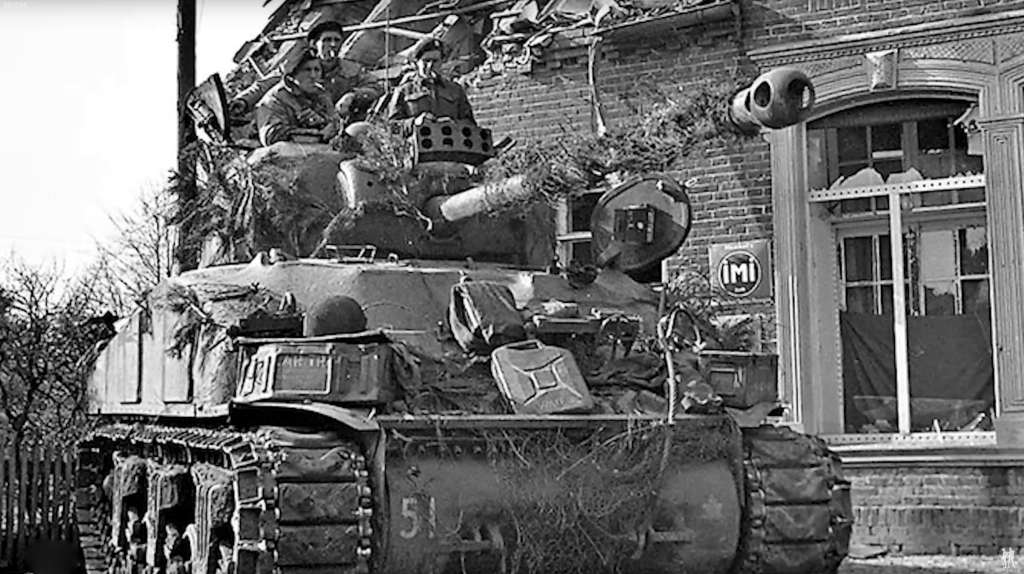
The next few days allowed the SFR to reconstitute its tank squadrons while Squadron C temporarily disappeared. Rad claimed a Mark IV and a Panther with a Firefly and lines remained static until July. He was promoted to Major on June 13th and put in command of A Squadron to replace one of several Majors who left because of battle fatigue.
Rad was learning the need to mass his fire and since he always led from the front, he always took his three SHQ tanks with him. If any troops lost a tank, he would have the survivors attach to his 3 SHQ tanks until a troop of three could be reconstituted. Meanwhile the massed guns was an effective response when the Germans revealed their positions when opening fire. Rad also realized that he had never been trained to respond rapidly because the instructors emphasized accuracy. In close quarters Normandy, the Sherman benefited from a rapid turret that could complete a full rotation in only 15s and fire as many as 15 to 20 rounds per minute. Hitting your enemy first automatically unnerves him even if it doesn’t prove fatal and repeated strikes have the opportunity to damage a drive wheel or track even if the Sherman has no hope of penetrating the armour. A disabled German tank is the same as a dead one. Their crews would rapidly evacuate before their prone tank was lethally hit and the ability of the Germans to retrieve and repair tanks in the field had never been good and was rapidly diminishing this late in the war. To accomplish this required complete situational awareness that is only possible with the Tank Commander operating with hatches open and his torso and head exposed.
The British and Canadians had pinned down the majority of the German divisions and were intent on breaking through by capturing the city of Caen giving the Americans the chance to outflank the Germans in an encirclement which would become known as the Falaise Pocket.
On July 4th, the British 8th Infantry Brigade would capture the nearby Carpiquet airfield while Rad and his squadron would conduct a diversionary attack to confuse the Germans. He successfully navigated the German mine fields while losing only two tanks to them and under cover of smoke navigated through the countryside shelling several small villages known to house German forces and knocking out two anti-tank guns. Unfortunately the taking of the airfield was only partially successful and the Germans still occupied the southern buildings.
The next day would be a full frontal attack preceded by an intense aerial bombardment, followed by artillery from land and naval units to eliminate all known enemy positions. The Germans were severely weakened and there were no reinforcements coming. The tactical thing to do was to retreat and regroup but Hitler had forbade that course of action. He still had illusions that his army could still counterattack and drive the Allies off the beaches.
Five hundred bombers dumped their ordinance over the Germans in the middle of the night followed by Typhoon ground attack fighters chewing up the Buron village stronghold. Ground and naval artillery pounded their targets all night long. It was hell to be on the receiving end. The Allied advanced at predawn with Rad ordered to take Buron with the Highland Light Infantry (HLI).
The Canadians had reorganized their troops in response to combat conditions. A Squadron had 15 tank with three troops of four and one SHQ tank. Each troop had 3 Shermans and one Sherman Firefly. Four Churchill flail equipped tanks to clear minefields and four Churchill flamethrower tanks were also attached. Rad ordered a smoke screen to hide their progress but his lead troop ran into an unexpected and well prepared German anti-tank ditch well covered by antitank weapons and remaining Mark IV tanks. Three tanks lost. On the left flank two tanks lost to handheld panzerfaust rocket weapons. And then two more from mortars and 88m antitank gun. The attack was being stalled by the minefield in front of the antitank ditch and Rad needed to get his tanks into Buron to support the HLI already in Buron. More smoke laid down and at 11:00 the engineers arrived with the flail tanks to clear a path though the minefield. The HLI had eliminated any enemies in the ditch while taking on very heavy casualties and Rad stormed through into the village with 6 tanks.
He spied an enemy tank, fired and missed. After several minutes of frantic manoeuvring which caused the enemy to miss several times and then deliver a glancing blow on one side while the Sherman finally found cover behind a stone wall. Finally able to meet up with about 25 surviving HLI in an apple orchard Rad devised a plan to clear the trenches of the well dug in defensive positions erected by the Germans. He drove his tank with his right track right in the trench firing at enemies in the trench with the coaxial machine gun and shooting HE rounds at the terminus of each trench. The most effective was the followup with the flail tank whose flailing five feet of chain and ball made a terrifying sight and ground shuddering thumping sounds as they hit the floor of the trench and turned bodies into unrecognizable residue.
Buron was secured, but Rad was down to 4 tanks and the HLI had lost 262 men. At 14:00 the Germans in nearby Abbaye Ardenne sent infantry and Panther tanks to counterattack. Rad called for tank reinforcements and five tanks from different squadrons came but not before being caught and several destroyed by the Panthers outside of Buron. Meanwhile the HLI had set up some antitank guns and four M10 tank destroyers arrived on scene. When the Panthers closed on Buron, Rad called in an artillery strike along with the fire from the M10s and Rad’s Shermans knocking out four Panthers before they retreated. They tried again and this time five were destroyed with only one escaping. By nightfall the Germans began to retreat back into Caen.

At 03:00 the next morning, orders were given to capture Caen. Squadron B got stuck in a minefield and came under fire from some Tiger tanks. Rad called in smoke, made his way left of B Squadron to enter from the north and picked up Squadron B’s Stormont, Dundas, and Glengarry Highlanders (SDG) and were inside the city in half an hour. Streets were blocked with rubble as high as 20 feet but they eventually made it into the city center. Civilian casualties were very high as were the Canadian ones, higher even than those suffered on D-Day with nearly 1200 dead. On the other side, two German divisions were essentially destroyed and equipment losses … irreplaceable.
The Sherbookes were pulled out of line for a much needed rest and Rad was inundated with the bureaucracy of command, writing new orders, decoration citations and letters of condolence. As Squdaron Commander, he had his own apartment built on a three quarter ton truck that was an office with a bed, spare kit and clean clothes and two gallons of rum. The men began trading candies, cigarettes and tinned sardines with the French for eggs, bread, butter and milk and the occasional livestock to slaughter and each tank had a designated cook. For Rad it was his long term driver who always made sure there was always something left for him to eat after returning from his liason time with infantry and troops. Regulations dictated that the men dig a trench to sleep in beside their parked tank in case of surprise mortar or artillery attacks. In reality, most chose to simply sleep inside the tank, somehow finding a comfortable position. Rad used to sleep on the back deck above the warm engine bay but out in the open.
Rad and Squadron A crossed the River Orne just outside of Caen on July 19th via a raft system constructed by the army engineers. The Sherbrookes were losing the infantry units of the 3rd Division that they had trained with so closely to adopt the rather green The Queen’s Own Cameron Highlanders of the 2nd Division. The Camerons did not know how to interact with the tanks and essentially fought separate battles ensuing greater loss of life. They were reluctant to lean into the artillery barrage as it travelled downfield and waited too long before moving thereby losing its cover and exposing themselves to enemy fire. But Rad mainly placed the blame on brigade level commanders who failed to be at the front to observe the wasteful loss of life and institute corrections.
Meanwhile Monty continued to grind down German forces in his sector while waiting for the Americans to make their eventual breakthrough.
Rad continued to handle his tanks with confidence, using smoke to hide his positions in the forest and allow his tanks to close within 500m where their small 75mm cannon would become lethal. The Germans predictably moved upwind to see better and the more agile Shermans would often beat them there, waiting in ambush. Tossing the Firefly in the mix often confused the Germans because it could engage as far as 2 km away and penetrate the frontal armour of a Panther, as it regularly did. Unable to determine the enemy position, one powerful German gun firing blindly and felling trees all around got lucky and penetrated two Shermans at once before damaging one of the bogie wheels of Rad’s own tank, “Caribou”. This was only the second time since D-Day that it had taken a hit and none of his crew had yet been injured but both the driver and bow machine gunner leaped out in expectation of an explosion. Rad figured the Canadian issued Shermans with their GM diesel engines gave them about 14 seconds to bail out, 5 seconds better than the British Chrysler gasoline powered Shermans. “Caribou” was easily identified because Rad has scavenged the track segment from dead Panthers and welded over a hundred of them around his tank to provide additional protection much to the consternation of Army Engineers who insisted the tracks would stop nothing but only cause early suspension and engine failure from all the additional weight.
Two stories of interest from this period.
One night, Rad was ordered to move to a night harbour location and his squadron were drilled to get into line and report over the radio. Sgt Miller was the the last man to report in with a Firefly bringing up the rear.
‘Are you the last man?’
‘No, there’s another tank behind me.’
Not knowing who it could be, Rad broadcasts with the call signs for him to respond but no reply.
‘Major Rad, it’s a German tank!‘ exclaims Miller.
‘For Christ’s sakes fire!‘
The German tank was only 20 meters behind Miller but Fireflys travel through the forest with their long barrelled gun facing rear over the engine deck to minimize getting caught on tree limbs so Miller had no trouble immediately blowing the German apart.
One morning, Rad spots over 40 German tanks in the open but just out of range of even the Firefly. Rad decides to try and call in an air strike for the first time. He talks to battalion HQ who goes to brigade HQ and then told to wait for the Air Support Unit from Division who are pilots riding around in jeeps who can signal aircraft. The hours go by until the evening when an RAF Squadron Leader with an enormous walrus moustache comes roaring in asking where the Hun is!

The details of Operation Totalize are described in my blog story about “Bomb” and showcase the stunning success of innovative Canadian tactics. In the early morning hours of August 8, 1944, the Canadians had broken through the line held by the German 89th Infantry Divsion leaving a 6 km wide gap. SS-Oberfuhrer Kurt Meyer watched as remnants of the 89th ‘stumble past us with fear filled eyes’. He had to stabilize the situation or the 5th and 7th Armies would be destroyed.
A rapid counterattack was formed with a group of 40 Mark IV tanks, self propelled antitank guns, and infantry supported by seven Tiger tanks of SS-Haupstrumbfuhrer Michael Wittman’s 101 Heavy Tank Battalion. Wittmann came from poor rural Bavaria and was seduced into become an ardent National Socialist as well as a poster hero for Hitler with nearly 140 tank kills to date.
Meanwhile Rad had been ordered to station his A Squadron on the heights overlooking the Caen-Falaise highway behind a large stone and cement wall surrounding a large chateau. He had eight tanks including two Fireflys and punched holes through the wall for firing solutions. Well across the highway and hidden in an orchard was A Squadron of the 1st Northhamptonshire Yeomanry, a British tank unit with one Firefly.
At 12:40 PM three of the five Tigers travelling in advance of the force passed within 700 m of the Brits and were all taken out by the Firefly.
Three minutes later a sole Tiger leading a pair of lethal Jagdpanther self propelled antitank guns passed within 400 m of Rad’s position. The squadron opened fire en masse and Rad confirmed taking out one Jagdpanther and most likely one or both Fireflys took out Tiger #007 confirmed to be commanded by Whittmann that day.

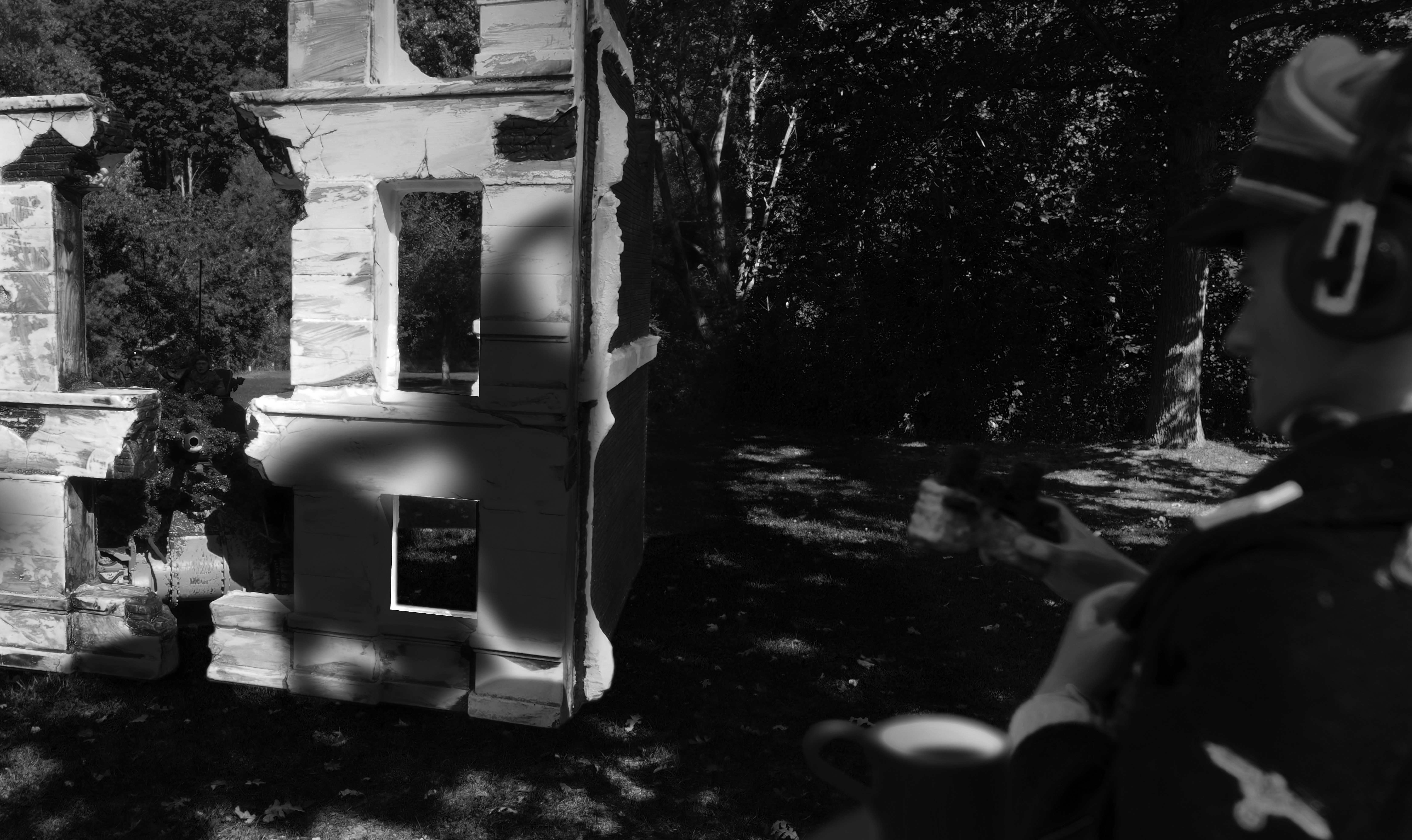
My m43 forced perspective recreation of this event. Click the above image for full screen and option to zoom in.
Rad led an undeniably charmed life and although “Caribou” would be hit (4x!) the crew escaped to safety. Soon enough he was having trouble sleeping and became increasingly reckless and arrogant in his behaviour before others recognized he needed leave and spent some time in the UK as an instructor. He returned to the Sherbrookes in time for the liberation of the Netherlands and the invasion of Germany with Caribou III, a Firefly Sherman. He was promoted to Lt Colonel and put in command of Sherbrookes in Holland and then brought them home. He made the Canadian Army a career and rose to the rank of Brigadier General.


 Jim Chung's Ramblings