


I encountered Saburo Sakai’s biography as Japan’s greatest living fighter pilot as a teenager at a used bookstore. I bought it on a whim and was amazed at a life lived by a man not even in his 30s and gratified to later learn that he lived a full and comfortable post war life. Part of his story and his success was determined by the aircraft that he flew, the Mitsubishi A6M Zero. This was a plane so advanced and so beyond what the Western powers predicted the Japanese could design and manufacture that it took years for the Americans to field aircraft to challenge its performance, and then in only certain parameters.
The Meiji Restoration propelled the Japanese to rapidly industrialize and emulate the economic successes of the Western powers in only one generation. Mao borrowed this playbook in his own Great Leap Forward of the late 1950s but his timetable of only a decade was too ambitious and disaster resulted with famine and 50 million Chinese dead. The West continued to despise Japanese products as cheap but admittedly decent copies. What the West failed to comprehend is that its society ran on capitalism and owners were always in conflict with the aims of employees. Not so in Japan where there existed a millennia of a clear nationalistic identity and workers functioned in harmony with owners. As it exists today in China and South Korea. Last year China launched a 1000 commercial cargo ships. The US built maybe three. South Korea launches a new ship weekly. And they are waiting to deliver the first of a new fleet of air independent propulsion submarines for the Royal Canadian Navy as early as 2032. Their success is because of their workforce. The US no longer inspires its young people to join blue collar labour, it’s easier to be an influencer.
Saburo Sakai’s story reflects the journey of his own country. He came from a long line of Samurai but that profession became irrelevant in the 20th century and they turned to farming, a hard life with which they displayed no talent. He rose to the top of his academics in his small village and a wealthy Uncle placed him in a prestigious Tokyo school where he failed miserably. In an effort to reclaim his honour, at age 16 he enlisted into the Imperial Japanese Navy where he was almost beaten to death so severe was the discipline. Upon graduation he enrolled into the Navy Flight School and was placed in a class of 70 from some 1500 applicants. Only 25 graduated in the class of 1937 with Sakai at the top of his class. The attrition was so intense that each pilot graduate was an elite but wars are not won by elite warriors but by logistics.
Japan had aspirations to join the Western powers given its long history of coexisting with two behemoth existential threats, Russia and China. Emulating Great Britain and its coexistence with the European continent, Japan projected her power with the third largest navy. This was no paper navy. During the first World War, the Imperial Japanese Navy fought battles that humiliated the Russian Far East Fleet and nearly decimated the Russian Baltic Fleet that came to the rescue. The rest of the world looked on with profound interest as this was the first instance of combat between steel battleships and radio communications to cooridinate individual fleet units. Just like recent conflicts in the Ukraine and Iran point to a future of inexpensive semiautonomous fighting machines.
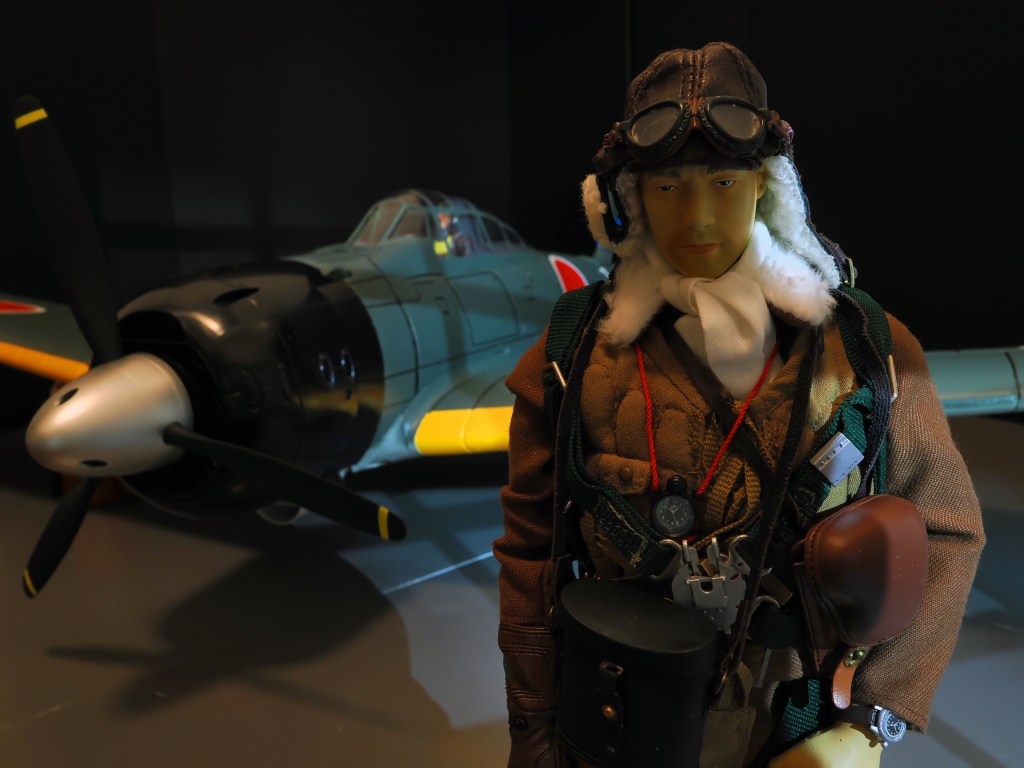
Even though the core home islands of Japan make up significantly more landmass than Great Britain, most of it is mountainous so Japan has little arable land to live on. She is so comparatively resource poor that everything must be imported. This is clearly reflected in the design and performance requirements that the Imperial Navy tendered for a new carrier based fighter, Prototype 12. It was a plane that had to do everything, and do it well.
Wingspan must be less than 12 m (to fit carrier space).
Maximum speed must be at least 500 km/h.
Range must be 1800 km fully loaded or 3000 km with drop tank. (this worked out to more than 8 hours in the air with the engine mixture leaned to the threshold of stalling. Sakai achieved a personal best economy of only 17 gallons consumed per hour).
Highly manoeuvrable.
Two 20mm cannons and two 7.7mm machine guns. (the inclusion of heavy cannons meant the plane had to function in the dual role of escort and interceptor).
A variable pitch propeller was the latest technology from United States and allowed the propeller to operate a maximum engine speed despite airspeed so this feature was added to the list.
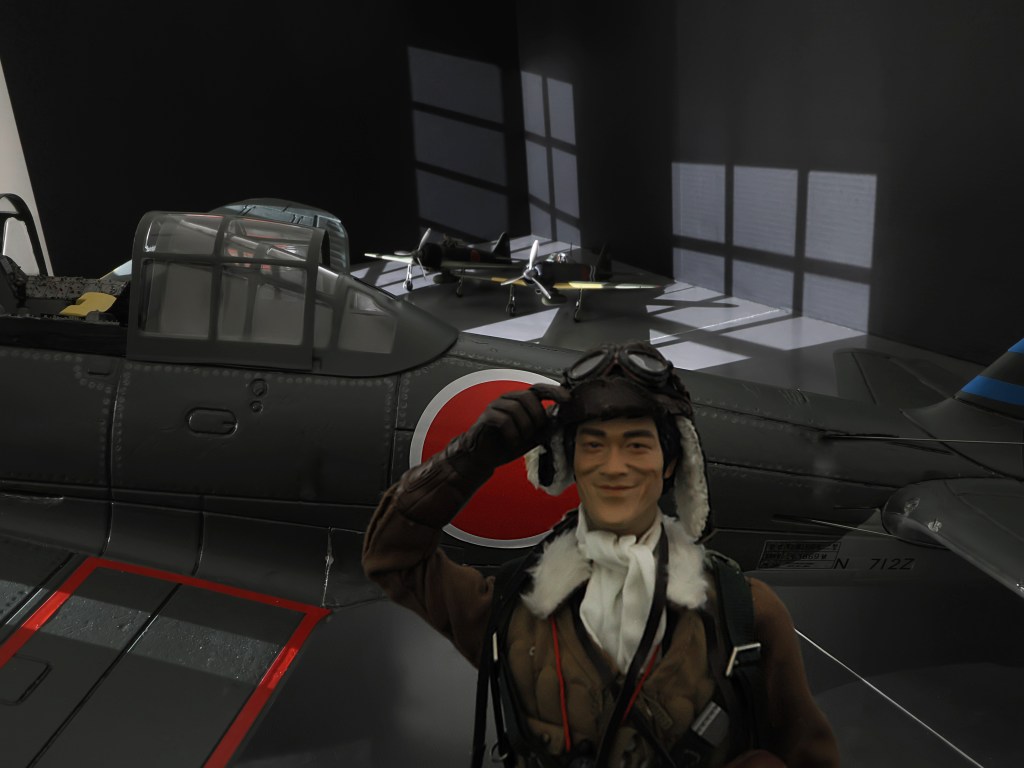
From the onset, it was clear that the design of the plane had to be as light and as aerodynamic as possible to achieve speed and endurance targets. Early in the design, it was realized that components in compression tended to fail at a higher force than those placed in tension which were stretched and deformed. It made no logical sense to have different failure points, so compressive components were lightened until they also failed at the same force rating.
A new zinc aluminum alloy was developed similar to modern day type 7075 with much higher strength than copper aluminum alloys of the period. Allied aircraft in fact did not use this alloy until well into the mid 1940s. Even components that could be made entirely in aluminum alloy to save as little as 70 grams were redesigned to do so. 3000 pages of drawings were generated and each one had to be checked for areas of weight reduction.
The fuselage was lengthened to provide more resistance to the recoil of cannon fire and the wing design required enough room for fuel storage, 20mm cannon ammunition, and a completely modern retractable landing gear to increase maximum airspeed. But a large wing did have aerodynamic penalties. The wing tips were twisted down so that the angle of attack decreases and limits the chance of the tip stalling and keeping aileron control even when the rest of the wing is approaching stall angle.
In the end, the total weight of the airplane was 1566 kg even though the projected weight was supposed to be 1534 kg. It turns out the engine, propeller and landing gear supplied by the Navy weighed 55 kg more than expected!
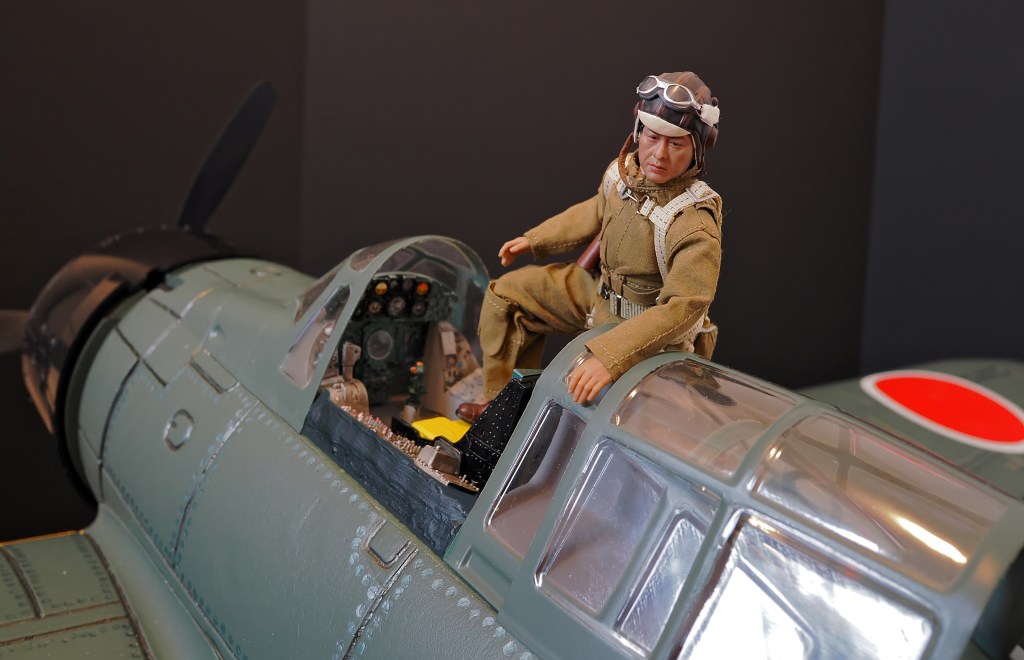
This zeal for weight reduction continued during missions when units would remove the entire radio system to further improve range. Early in the war, the phenomenal range for the Zero would often make the Allies believe that Japan had more operational aircraft than they really had. But this practice also had its downside. Pilots would be fatigued after flying 4 hours and then spend half an hour on target before having to return home. A fatigue that could continue day after day after day as Japan lost its best pilots with too few in the system to replace them. Then their solution was to graduate less than competent pilots to no avail.
The large wing and light weight allowed the Zero to turn tighter than any other fighter ever made. In low speed dogfights this was deadly as the Zero could quickly close with its target and easily match any manoeuvre from any Allied aircraft. In response, Allied pilots flew with teamwork so that wingmen watched their backs and never engaged Zeros on their terms. Instead Allied pilots would dive at high speeds and execute hit and run attacks and quickly dive away to escape. Finally an intact Zero was captured on the Aleutian Islands and carefully examined. The fighter had no armour plating to protect the pilot or self sealing fuel tanks. Clearly a great deal of time and labour had been spent in fabrication and the US technicians marvelled that the wing and fuselage was assembled as one unit, the flush rivets to keep the airframe skin slippery, and the overall watch like quality of assembly.
Sakai also criticized the lack of teamwork even within his own squadron. Pilots attacked like overexcited, individual Samurai warriors and often got in the line of fire of another pilot or had to madly swerve to avoid midair collisions. Sometimes the enemy escaped in the melee of confusion. Allied aircraft continued to improve with increasingly more powerful engines and ever better pilot protection but they were never able to match the manoeuvrability of the original Zero.
.
.
.
Now you’ve been eagerly waiting to hear about the LBJ connection. If LBJ died during the war, who would be JFK’s VP? Would JFK still have carried Texas and won the Presidency without LBJ? Would the Civil Rights Act ever be passed without the legislative acumen of LBJ? Who knows. But we do know this.
Lyndon B. Johnson was a 33 year old Texas Congressman who volunteered for naval duties after Japan declared war on the US. Having absolutely no military experience, he attached himself to General Douglas MacArthur in Australia and won him over. Ultimately he convinced MacArthur to allow him to participate in one combat mission, even as an observer.
On June 9, 1942, LBJ climbed aboard the twin engined B26 Marauder bomber named Wabash Cannonball for a bombing mission over the Japanese base of Lae in New Guinea. He was warned that 25% of each mission would not return because the US had no fighters to spare to escort and protect these bombers. Sakai mentions the courage of these unescorted bomber crews time and time again in his biography. Still, LBJ was game and took the last seat. Then he either forgot his camera or needed a last minute bathroom break. When he came back, the seat was gone and he sheepishly boarded the nearby B26 Hecklin’ Hare.
Sakai writes very briefly about that raid and that he shot down two B26s that day, one being the Wabash Cannonball, which crashed into the Pacific killing everyone on board. The Hecklin’ Hare developed electrical problems and jettisoned their bombs early but still were attacked by Zeros as they reversed course and escaped.
MacArthur decided to award the prestigious Silver Star medal for bravery to LBJ, who sincerely felt it was undeserved. But he did not refuse it and it clearly helped him win a seat on the Senate in 1948 and he wore it daily pinned to his lapel.
The son of the man who had occupied the last seat on the Wabash Cannonball later became a US Army Colonel himself and later met Saburo Sakai in 1987 at the Yakima Airshow in WA. He spent the night at his home and with an interpreter had long conversations. Sakai still had his helmet and scarf that he wore, bearing the bullet damage that crippled his right eye. On hearing that his host had a daughter entering the US Air Force, he tore a piece of the scarf as a talisman to protect what he considered was a worthy extension of the warrior line.

 Jim Chung's Ramblings