


Another momentous day in Canadian history has just past at the beginning of this week and it happened 79 years ago. And so I feel compelled to write about it. It celebrates what may be the most famous photograph taken of Canadian involvement in World War 2 showcasing the talented and brave work of members of the Canadian Army Film and Photo Unit (AFPU). They would often be right at the front in the thick of combat in order to document history with stills and movie footage. I knew one of them very well. He was a patient of mine when he retired to live in British Columbia and his name was Ken Bell. Lieutenant Bell hitched a ride with the Highland Light Infantry on the second wave of the Juno landings on D-Day, armed only with his Rolleiflex camera loaded with colour film. Ken captured the brutal street fighting to liberate the French city of Caen, and followed the Canadian infantry across Normandy, through Belgium and the liberation of the Netherlands and into Germany.
After the landings at Normandy in early June 1944, the Allies failed to breakthrough significantly past their secured beach heads for two months. The British and the Canadians took nearly that entire period to defeat the Germans holding Caen and the Americans in the West were similarly bogged down by the extensive network of hedgerows or “bocages” throughout the French farming countryside which aided the defending Germans. But in August the situation rapidly changed and German Army Group B consisting chiefly of the 7th Army and 5th Panzer Army found itself trapped in a region referred to as the Falaise Pocket sandwiched between the armoured elements of the British, Canadian and Poles to the North and the Americans to the South.

Feldmarschall Erwin Rommel had been in command of Army Group B until a month earlier when he had been grievously injured after his Horch¹ 830 staff car had been spotted by a Spitfire from Squadron 412 RCAF flown by Flight Lt. Charley Fox of Guelph, ON. He had time to line up only one pass as the driver was heading for the cover of a side road and Fox saw his 20mm shells hit the driver, the out of control car rammed a tree stump and Rommel was thrown out and suffered head injuries. Rommel’s replacement, Günther von Kluge, had been repeatedly appealing to Hitler as late as August 14th that his men must withdraw or face eradication but Hitler demanded that his forces counterattack. Kluge finally issued an order for retreat on the night of August 16th despite not having permission from Berlin and was relieved of command and recalled. He committed suicide enroute believing he was implicated in the recent assassination plot on Hitler. By this time the Germans were nearly encircled but senior officers had quietly arranged for administrative staff and noncombat worthy troops (tank crews with no tanks) to leave days earlier, as many as 65,000 men.
¹ Horch is one of the four car companies that made up Auto Union, the four rings that symbolize modern day AUDI.
On August 18th, General Montgomery began to realize that the trap could only be closed further east between the French towns of Trun and Chambois and he gave orders for the Canadians and the US 3rd Army under General Patton to link up in that region however owing to some confusion the American attack was delayed for THREE days. Major David Currie commanding C Squadron of 4th Armoured Division of the 29th Armoured Reconnaissance Regiment, also known as the “South Albertas”, was ordered to seize the town of St. Lambert-sur-Dive midway between Trun and Chambois where the only bridge large enough for German vehicles and tanks to cross the Dive river lay on today’s Highway D13 leading into town. C Squadron was understrength with only 15 tanks but then so were the B Company infantrymen of Princess Louise’s Argyll & Sutherland Highlanders (ASH) that had been also assigned to Currie. With a total of only 130 personnel and no promise of artillery support, Currie looked across at the open valley floor and five centuries of peaceful existence that was about to end. Just the day before, his tank troopers had driven through an apple orchard and the Shermans’ turrets had swept across the lower limbs harvesting a bounty of ripe apples through the open hatches.
Currie’s group arrived at the northern outskirts of St. Lambert-sur-Dive at dusk. Suddenly, the lead Sherman was hit and destroyed by German 88mm antitank fire leaving two of its crew wounded. Currie’s own tank then mistakenly came under attack by RAF Spitfires who injured the crew of another tank that had their hatches open. Their second pass took out the medical halftrack and injured its driver despite the ignition of yellow smoke to signal to the fighters that they were friendly. Although an inauspicious start, Currie maintained his aura of cool professionalism that would carry his men through the harsh events of the next few days. They pulled back to a defensive position on a large flat topped hill and Currie alone and on foot scouted the German positions for their armour and antitank gun emplacements. His commanding officer and the Regimental HQ troop with the rest of the regiment’s tanks including four M10 tank destroyers joined Currie on the hill at midnight.
The next morning, three Shermans reentered town and penetrated 300 yards before the lead was hit by antitank fire. The crew escaped but the wounded driver was rescued by infantrymen. The tank commander of the second Sherman got hit in the shoulder by sniper fire but shrugged off the injury and pressed on until his tank was hit by an AP (armour piercing) round delivering shrapnel to his face and knocking teeth out. His crew bailed out as the tank burned and he was rescued by the third Sherman. A PzKpfw Mark IV and a Tiger tank were spotted at the southern end of town and Currie’s gunner hit the Mark IV with a HE (high explosive) shell and then 6 AP shells before the tank exploded after its own ammunition went off. The infantry couldn’t find the Tiger but spotted a Panther. They traded automatic gunfire with the emerging German tank crew and threw grenades down its hatches. A PIAT later finished off the Panther. Currie brought all his tanks into town to support the infantry and secured the village. He set up three tanks at the southern crossroads and withdrew north of the village to set up the remainder of his tanks in defensive positions covering fields of fire to the West where the Germans were appearing.
Hundreds of German troops started seeping into town from the surrounding orchards and hedges who were eager to surrender but Currie simply did not have enough men to guard them all. These were not combat soldiers but members of communication, construction, garrison, transport, and signals units and not ethnic Germans but Armenians, Kazaks, Turkmen, Ukrainians and Georgians who had been pressed into service. These soldiers were disarmed and sent marching down D13 towards Trun and the Allied line with strict orders not to stray from the road or otherwise be shelled by tank fire. Valuables like watches, pens, medals, Nazi regalia and money were confiscated but personal effects were generally returned. There were plenty of Germans in town who still wanted to fight and snipers kept targeting Currie’s officers. Tanks of the entire regiment were busy engaging German armour throughout the morning while truck drivers continued to resupply the unit with fuel and ammo having to dodge intermittent enemy fire at great personal danger. Who wants to drive a slow 3 ton truck loaded with 1000 gallons of gasoline?
By noon things had quieted down in the town and Currie was back at the intersection when two Jeeps with members of #1 Canadian AFPU drove up after hearing a rumor that the Americans would be arriving to link up with the Canadians. Here they spent two hours shooting stills and 16mm film of B Company of ASH and Currie controlling the village and taking German prisoners. Then there was the sudden appearance of a BMW R75 motorcycle with sidecar containing a German officer wearing a peaked cap and goggles leading a halftrack full of soldiers. After recovering from his surprise, Captain Sigfried Rauch, 2nd Panzer Division, dismounted and regained his arrogant Aryan attitude while surrendering the entire column with no loss of life.


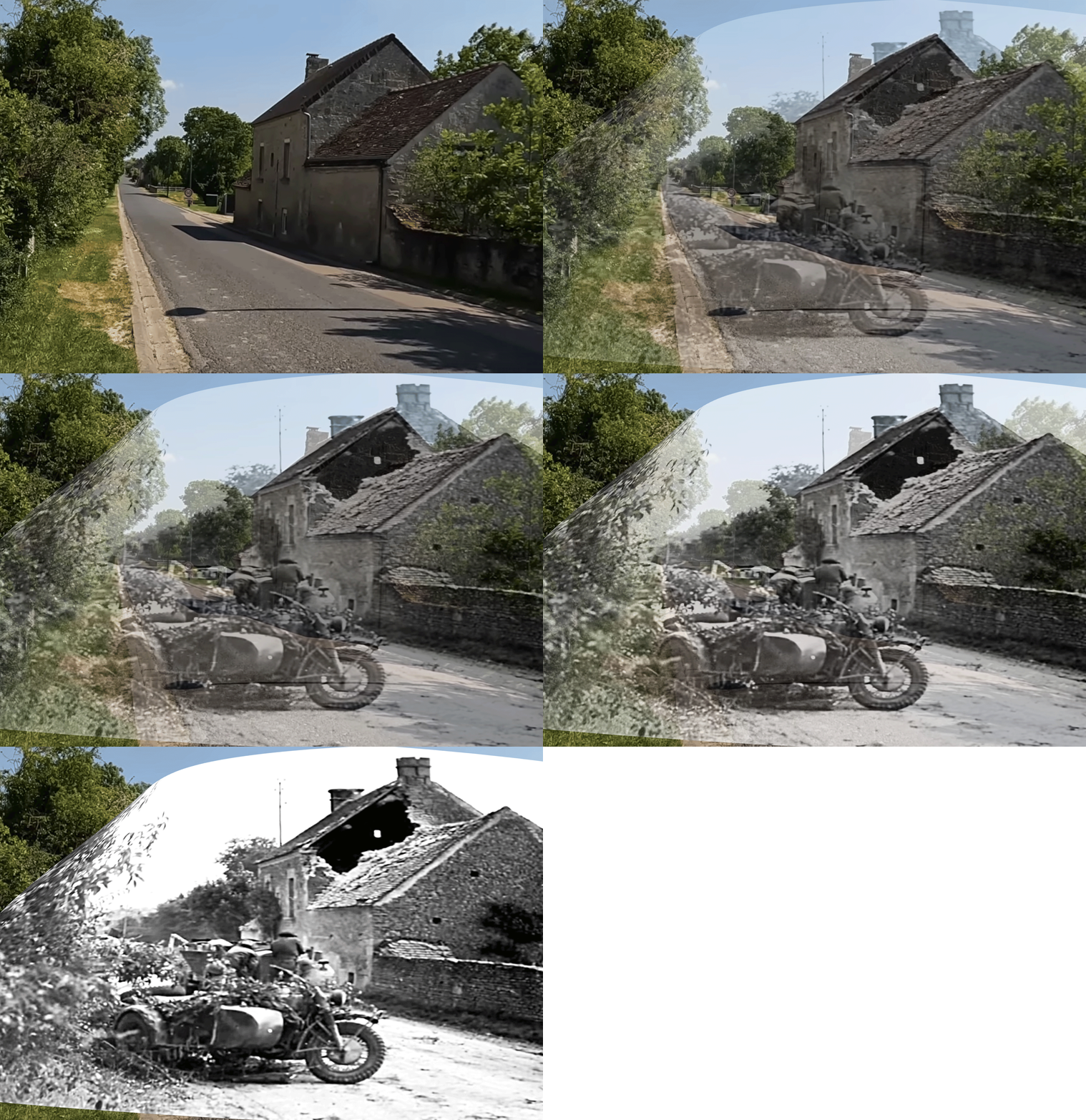

But by midafternoon the situation began to deteriorate as more Germans flooded the region with the frenzy of a desperate cornered animal. There was no coordination to their attacks and firefights broke out all over that would end as suddenly as they began. Even sporadic German artillery began to fall on Currie’s position. Allied artillery support had been reestablished and Currie called down fire on his tanks as their ammunition was running low. Expecting 25 pound shells that would do no damage to his tanks and the crews buttoned up inside them, Currie was horrified to see far heavier ordinance fired from 6 inch guns landing 15 yards away that could rip his tanks apart if they scored a direct hit. Luckily the Canadians suffered no injuries but the effect was devastating to the Germans.
C Company of ASH had been sent to reinforce Currie but he still did not have enough men to hold the town and prevent Germans from entering at nightfall. In the middle of combat, the brigade quartermaster called Currie and asked him for the number of binoculars accounted for by his squadron in an effort to keep on top of theft and loss to black market operations. With quintessential Canadian politeness, Currie replied, “I’m a little busy now, I will have to call you back.” Unknown to the Allies was that the final breakout that was to occur tomorrow on the morning of the August 20th would involve hardened combat troops who had experience from the Russian Front in breaking out of encirclements. This included remnants of six panzer divisions, seven infantry divisions, one parachute division and over a hundred amoured fighting vehicles that had been hidden under the forest canopy or bales of hay biding their time.
The German paratroops began their infiltration of the town at night under the cover of rain but their goal was not to engage the Allies but try their best to navigate around their tank and infantry positions and attempt to regroup by morning to support the main body of tanks and men who would be attempting to cross the bridge and penetrate through St Lambert-sur-Dives in the morning. The morning sky was severely overcast so there would be no air support this day. By 8:00 AM, the Germans hit the St. Lambert with waves of infantry and tanks. Currie’s small force was pushed from the southern parts of the village to the north and was basically spared because the Germans were more interested once they crossed the Dive to head East. But as the Germans bore down on them like an army of ants, crawling all over their tanks because they lacked infantry support, the crews had to traverse the turret and main gun to knock them off the tank body and crack open hatches to fire through slits with Stens and sidearms. Currie, crouch standing in the open commander’s cupola was firing his rifle at snipers intent on shooting at him.
The South Albertas evacuated both German and Canadian wounded in their ambulances and despite displaying the vivid Red Cross of the medical services, suspicious German troops would often raise their weapons only to let the vehicles pass through their lines when they saw their wounded comrades being treated so humanely. In turn, the South Albertas did not fire on German vehicles bearing the Red Cross but they became so numerous that one tank commander had had enough of what he determined was a subterfuge and put a HE shell through a German ambulance which erupted with an enormous explosion. It had been carrying ammunition and not wounded.
Currie once confronted an entire convoy of legitimate German ambulances stuffed with injured Germans like so much firewood that he convinced the German doctor it was better to turn around and take them to the Canadian hospital. Once there, German and Canadian medical personnel worked in concert and triaged patients with no distinction to the uniform worn by the injured. The ranking Canadian medical officer spied a German officer in immaculate uniform complete with polished jackboots and identified him as a Major and a doctor who had been head of surgery in his hospital before the war.
Well, give me a hand.
I would be happy to except I only take orders from superior officers.
My Colonel instructs me to shoot you if you do not comply with my order.
And with that the German Major saluted and got down on his hands and knees to work and turned out to be extremely skillful and gratifyingly bloody. But not all Germans were stereotypical rulemongers. A medical sergeant from a Panzer unit burst into tears when given a bag full of morphine syringes.
By the afternoon, there were still no forces available to relieve Currie and he was barely holding on. He positioned his remaining five Shermans and about 120 infantrymen around and within the buildings surrounding his HQ and continually harassed all the Germans passing through St. Lambert so effectively that their commanders thought a whole squadron of tanks were trying to break through the town from the north while others were keeping the road northeast from St. Lambert under constant fire. Along with persistent Canadian artillery, Currie kept the Germans from penetrating further into town but could do little to stem the flow of escaping soldiers. Currie kept busy visiting all his men and keeping them apprised of the situation in his calm, easy going, matter of fact style. Firing started to become sporadic in the late afternoon and by the very early morning of August 21st, Currie who had had no sleep for three days finally relaxed enough to instantly fall asleep on his feet and was caught by his men before he fell to the ground.
The consensus is that the Allies captured about 50,000 German and nearly destroyed all of their equipment. But the inability to actually close the Falaise Pocket meant some 170,000 combat experienced troops escaped and were able to regroup and fight again during the Battle of the Bulge. Heads did roll for the failure of destroying Army Group B, but those heads did not include David Currie. He was awarded the Victoria Cross for his leadership and action of his men under the most trying of circumstances. C Squadron and the ASH infantry has destroyed seven German tanks, twelve 88mm antitank guns and 40 vehicles. They had killed 300 Germans, wounded 500 and captured 2100.


Addendum: August 29, 2023.
I am a little reluctant to add this to the end of a very long blog entry but it’s an important revelation. The Allies could have securely closed the Falaise Gap and prevented, by the best estimates, the escape of over 200,000 German soldiers. This would have had enormous implications on how the war ended in Europe from shortening the war in the West, reduced casualties and arriving sooner to Berlin and preventing the expansion of Soviet territories.
Modern historians lay the blame squarely on the shoulders of British General Bernard Montgomery, a difficult, antisocial man with no empathy and poor group skills. Having been stung previously by a race with American General Patton to seize the capitol of Sicily, Montgomery could see the Americans were progressing far more rapidly than the Commonwealth Forces and would be able to take full credit for closing the Falaise Gap. Not being able to tolerate what he perceived was yet another personal indignation, he ordered American General Bradley to order Patton to stop his progress on August 13.
Patton saw through the ruse immediately and wrote a few days later “ …. was either due to [British] jealousy of the Americans or to utter ignorance of the situation or to a combination of the two. It is very regrettable that the XV Corps was ordered to halt, because it could have gone on to Falaise and made contact with the Canadians northwest of that point and definitely and positively closed the escape gap.”
Bradley had appealed right up to the Supreme Commander himself, Eisenhower, who agreed that stopping Patton was wrong but more dangerous was the word getting out to American journalists that Montgomery had the effontery to issue such an order. It would destroy the Anglo American alliance. So for political reasons, Eisenhower asked Bradley to issue the halt order in his name.

 Jim Chung's Ramblings
Excellent article, but respectfully suggest you change 89 years to 79 years (2024 is the 80th anniversary of this action)
LikeLike
Thanks Alan and now corrected!
LikeLike
Great, thanks, it certainly wasn’t a show stopper on a superb article. You might also wish to amend “Turks” amongst surrendering enemy soldiers, as they were not from Turkey, where the generally used word Turk comes from, but most probably from the (then) Soviet republic of Turkmenistan, I believe that they are called Turkmen, and “coerced” in to the German armed forces, along with other Soviet soldiers as a better option than starving to death. Although when returned to the Soviet Union at the end of hostilities death was their most likely fate, as happened to the Cossacks returned from Austria post VE-day under existing agreements to return released citizens of one allied country to their own country.
https://en.m.wikipedia.org/wiki/Turkmenistan
LikeLike
This is all correct from what I can tell. As a matter of interest, I’ve also seen “Turcomen” as another variant spelling. Having said that, I am as impressed as you are by the quality of this article, most impressive analysis of the photos and history.
LikeLike
Spot on, I too was initially confused at how Turkish soldiers could be involved!
LikeLike